Engineering and OEM sourcing guide for importers, wholesalers and private-label teams
Bamboo Drawer Organizer Manufacturer: Fit, Tolerances and OEM Control
The short answer
A dependable bamboo drawer organizer manufacturer starts with measured drawer data, not one attractive sample. The product must fit a stated range, expand without binding, stay square under uneven utensil loads, protect the drawer, and repeat the approved appearance across production. Buyers should freeze the finished dimensions, tolerance stack, expansion force, divider layout, materials, coating, packaging and inspection method in one controlled specification before placing a bulk order.
For an expandable model, test at minimum width, nominal width and maximum width inside real drawers. Cycle the mechanism, load both wings, check rocking and finger-clearance points, then repeat the checks after reasonable humidity conditioning and packaged transport. Compare suppliers on the same revision and Incoterm. The lowest price is not comparable if it assumes thinner components, a narrower expansion range, simpler packaging or fewer inspections.
A bamboo drawer organizer manufacturer may make the item look simple until the first production run reaches thousands of kitchens. Then the details become commercial: the widest unit rubs the drawer wall, a wing creeps inward under load, a divider slot is tight after finishing, or a carton corner marks the visible bamboo face. Every one of those outcomes can be prevented with a clearer brief and a test method that matches the customer’s use.
Ningbo Newline develops bamboo and wood household products across home storage, kitchen, bathroom and office organization. When a buyer evaluates a bamboo drawer organizer manufacturer, the work should start by turning the brand idea into a measurable production file. Product geometry, material behavior, finish, labels, packing and shipment evidence belong in the same project. A universal “standard bamboo organizer” does not exist; each program needs controls that reflect its channel, target customer, destination and drawer population.
Have a drawer reference or target retail price?
Send the internal drawer dimensions, preferred compartment layout, expected volume, destination market and packaging channel. Newline can review the fit strategy and identify the decisions that affect feasibility, sample time, MOQ and cost.
1. Define the consumer job before choosing the organizer
When I review an organizer brief, the most useful reference is often an ordinary, slightly messy drawer.Measure its usable space and place the owner's utensils on the table. In a city flat, short cutlery lanes may matter; a deep family-kitchen drawer may also hold foil rolls, whisks and peelers. Note the longest object and what is grabbed daily. From that small exercise, sensible compartment depths and divider positions emerge—and sometimes it becomes clear that an expanding wing adds no real value.
Write the promise as observable behavior. “Keeps a twelve-place cutlery set separated while fitting common 400–520 mm internal drawer widths” is useful. “Premium expandable organizer” is not. The first sentence can be translated into measurements and trials; the second invites every supplier to make a different assumption. If the product is intended for several markets, record which drawer ranges are based on real measurements and which are still estimates.
The sales route changes the brief even when the organizer does not change. On a store shelf, the package has seconds to explain which inside drawer measurement matters. Online, the listing needs both end-point dimensions, an honest view of the sliding action and a parcel pack that can take rough handling. A distributor may care more about neutral labels, mixed cases and quick replenishment. Put those channel differences in the project file; otherwise the same product can arrive with the wrong instructions and the wrong promise.
The commercial objective matters too. A pilot may need to prove that the chosen width range covers enough households. A mature line may need a smaller footprint, fewer returns or a lower carton cube.A private-label team may want a visual family across drawer, countertop and pantry storage. State the first-season objective. It tells the manufacturer which tradeoffs deserve attention and which features are decorative distractions.
2. Build a drawer-fit dataset instead of guessing a universal size
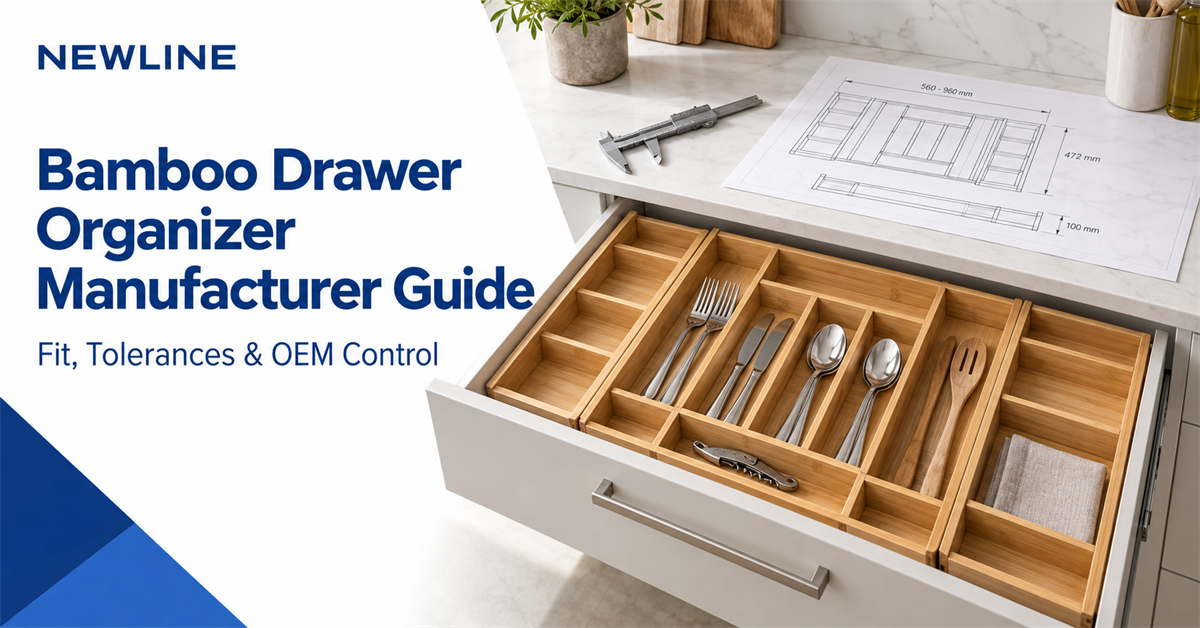
Nominal cabinet sizes are not the same as usable drawer dimensions. Side-wall thickness, runners, corner radii, back profiles, face-frame construction and internal obstructions all reduce the space available to the product. Two cabinets sold under the same nominal width may have different internal envelopes. Collect inside width, depth and clear height from representative drawers. Note any screw heads, rails or curved corners that could touch the organizer.
Use the dataset to select a coverage strategy. One wide-range expandable organizer may cover many drawers, but the mechanism and packaging become larger. Two size bands may fit better and reduce excess wing exposure, yet they add SKUs and inventory. A fixed organizer can be stable and simple, though it transfers the fit decision to the shopper. There is no automatic winner. Compare coverage, cost, shelf communication, returns risk and reorder complexity together.
Do not choose the maximum stated expansion by adding the two side-wing widths to the central body. The working range must include clearance for real motion, wall contact and production variation. If the organizer relies on friction against the drawer sides, define the contact system and expected holding behavior.If it is merely expanded to occupy space, make clear that the wings should remain where the user places them without scraping the drawer.
| Fit input | How to collect it | Design implication | Typical mistake |
|---|---|---|---|
| Inside width | Measure front, middle and back at drawer base and organizer height | Sets compact width, working range and wall clearance | Using nominal cabinet width |
| Usable depth | Measure to the first back obstruction, not only the drawer box | Controls overall length and long-tool compartments | Ignoring the sloped or inset back |
| Clear height | Close the loaded drawer slowly and check handles or stacked utensils | Controls wall height, divider height and spoon stacking | Measuring an empty drawer |
| Corner and hardware clearance | Record radius, runners, fasteners and side projections | May require feet, chamfers or a smaller base envelope | Testing on a flat table only |
| Target utensil set | Measure representative long, wide and nested items | Determines compartment lengths and removable-divider value | Designing from icons instead of real tools |
| Coverage target | Rank drawer measurements by market and expected sales mix | Supports one-size, two-size or fixed-size architecture | Calling one sample “universal” |
When the dataset is incomplete, document the assumption and test it before scale.A small measurement exercise with staff, retail partners or cabinet installers can be more useful than another round of styling. Keep the raw measurements. They allow later revisions to improve coverage without debating why the original width was chosen.
3. Choose an expansion architecture that can be manufactured and inspected
Most expandable organizers use sliding side wings, overlapping trays or telescoping frames. The visible form may be similar, but the load path and production controls differ. A wing supported on runners must move smoothly, avoid excessive vertical play and stay aligned at full extension. An overlapping tray needs enough support to resist tipping when the outer compartment is loaded. A telescoping frame may use more components and joints, which increases inspection points.
Request one sectional drawing through the slide, not another beauty photograph. A bamboo drawer organizer manufacturer should mark the rail profile, remaining overlap at the working limit, contact faces, stop, joint, bottom support and pad location. Read the section at full extension. It may show that the wing is hanging on a narrow ledge, that a finger can enter a pinch point, or that coating thickness will remove the running clearance. These are inexpensive lines to change on a drawing and costly surprises in a finished batch.
Expansion feel is part of the product. A unit that moves too freely can drift during loading. A tight unit may jerk, scratch or encourage the shopper to pull on a weak wall. Define how the organizer should behave rather than relying on “smooth.” A practical sample evaluation records the force needed to start motion, the feel through the range, audible rubbing, side-to-side play and the ability to hold position under an agreed uneven load.
Mechanical stops deserve attention. They can prevent a wing from being pulled past its safe overlap, but they also create small components or machining features. If no stop is used, instructions and geometry should make the limit evident. Test misuse that is reasonably foreseeable: lifting the organizer by one extended wing, loading the outermost compartment first, or pushing the unit closed while a utensil blocks the rail.
4. Convert product dimensions into a controlled tolerance stack
Tight numbers are not automatically good engineering. Spend precision where two parts meet or where variation changes use: body width, rail clearance, wing width, overlap and the outside faces that enter the drawer. A decorative recess can usually tolerate more movement than a divider slot. Mark each dimension by the failure it prevents—binding, loss of support, rocking, a poor carton fit or an obvious visual gap. The result is a tolerance stack the production team can hold without charging for needless accuracy.
Write finished-product dimensions, not rough component dimensions, on the buyer drawing. Bamboo parts may change through machining, sanding, coating and assembly. A slot that accepts an unfinished divider can become tight after coating. A panel that is flat before assembly can introduce stress when fixed into a frame. The inspection method needs the final condition and a consistent measurement location.
Use datum points.Overall width measured across soft non-slip pads is not the same as width across bamboo walls. A compartment length measured at the top can differ from the base if the walls taper or have radiused corners. Define the surfaces and tool. For features that depend on feel, pair a measurement with a functional check. A rail clearance can pass a caliper check while still binding because the frame is not square.
| Characteristic | Why it matters | Recommended control | Verification point |
|---|---|---|---|
| Compact overall width | Determines the smallest drawer served | Finished dimension at defined wall height | First article and final inspection |
| Maximum working width | Determines coverage and safe overlap | Functional limit with stated overlap | Cycle and load test |
| Body squareness | Controls fit, movement and visual gaps | Diagonal comparison or fixture | After assembly and conditioning |
| Slide clearance | Controls force, noise and marking | Critical cross-section dimensions plus function | In process and after finishing |
| Divider-slot width | Controls assembly and customer reconfiguration | Go/no-go gauge with coated parts | After finish cure |
| Base flatness | Controls rocking and drawer contact | Reference surface and agreed gap method | Loaded and unloaded |
| Carton inside dimensions | Controls compression and movement in transit | Packed sample and specification | Packaging approval and shipment |
A responsible supplier will question unrealistic tolerances. That is useful. The goal is not to demand precision everywhere; it is to place reasonable limits where variation would create failure. Ask for capability evidence on the characteristics that matter.A few first-article measurements, followed by production sampling, can be more informative than a polished specification that the process cannot hold.
5. Specify material construction, not only “natural bamboo”
Bamboo reaches the factory as strips, laminated panels and components prepared in different ways. The product specification should identify the visible construction, nominal component thicknesses, lamination direction where it affects appearance or movement, acceptable repairs, and any engineered bottom panel. If a concealed panel or non-bamboo component improves flatness or cost, state it accurately rather than allowing a broad material claim to hide the build.
Grain direction should support both appearance and strength. Long side walls usually benefit from continuous visual flow, while thin cross-pieces need enough section and sound machining at their ends. Narrow dividers can split if the grain, slot fit or assembly force is unfavorable. Review the smallest section, the thinnest wall around a slot and every point where a customer may pry or pull.
Natural color variation is expected; uncontrolled appearance is not. Divide surfaces into zones. The top rim, front wall and exposed wing faces may need tighter limits than hidden undersides. Approve representative high and low color samples under agreed lighting. A single digital photograph cannot define the range because screens, exposure and white balance change perception.
If the order uses an FSC claim, verify the certificate scope and transaction claim rather than accepting a logo in a presentation. The Forest Stewardship Council explains that chain-of-custody certification tracks certified forest-based material through manufacturing and distribution. The purchase, invoice, product group and trademark approval process must support the exact claim used on the finished pack.
6. Treat moisture as a process condition, not a marketing number
Moisture readings are easy to quote and easy to misuse. A bare percentage says little unless the report names the meter setting, check method, sampling points, sample count and product condition. Walk the sequence: where panels are conditioned, how parts wait between machining and coating, and how finished units are stored before packing. Then agree what happens to an outlier. Construction, season, factory air, ocean route and destination climate all influence the useful limits, so the method belongs beside the number.
Measure more than an accessible top surface. Thick walls, laminated panels and nested packaging can create different moisture histories. Keep the sample method practical enough for production and final inspection. If the destination has a dry climate, a humid factory-to-container route, or a long sealed transit, consider a pilot with retention samples. Review flatness and slide action again after conditioning rather than assuming a pass at the factory is permanent.
Packaging can help or hurt. A barrier bag may slow moisture exchange, but sealing a damp product can trap the problem. Desiccant is not a substitute for dry goods and controlled storage. Carton ventilation, warehouse humidity, container loading time and port exposure belong in the risk review.The supplier should explain how product, inner pack, master carton and loading sequence work together.
Keep “waterproof” off the package unless the finished product has truly been validated for that claim. This organizer belongs in a dry drawer, though a shopper will probably wipe it with a damp cloth and may spill something nearby. Test and describe that realistic care. “Wipe clean and dry promptly” can be both useful and supportable; borrowing the most optimistic property associated with raw bamboo is neither.
7. Define finish, touch points and cleanability
The customer handles the top edges, divider ends, wing grips and compartment corners. These touch points deserve explicit standards for radius, sanding, splinters, coating build and residue. Inspect them with fingers as well as light. A surface can look smooth from above while a slot edge remains sharp. Where utensils slide into narrow compartments, finish quality is more noticeable than on a broad panel.
Specify the coating system by approved product identity or controlled performance, then lock change approval. Discuss color, gloss, odor, cure, wipe resistance and compatibility with adhesives or anti-slip pads. A generic “food-safe finish” is not enough for a drawer organizer, and it can be misleading if the product is not marketed for direct food contact. The requirement should reflect foreseeable use and destination-market obligations.
Cleaning instructions influence design. If the item is intended for wipe-clean care, narrow blind corners should not trap crumbs.Removable dividers should come out without tools and return without damaging a tight slot. If the customer may place the organizer in a dishwasher despite instructions, warnings and online copy must be clear. Product design should reduce the temptation to use an unsuitable cleaning method.
Use a signed finish sample and limit samples for natural variation, gloss or acceptable small marks. Keep one protected reference at the factory and one with the buyer or inspection party. Record the date, product revision, coating and approval status. A photo helps communication, but the physical sample remains important for touch, odor and sheen.
8. Engineer compartments around real utensils and user behavior
More compartments do not necessarily make a better organizer. Nine narrow cells may photograph well and frustrate anyone trying to lift the last fork. Load prototypes with cutlery and tools bought in the destination market: steak knives, chopsticks, serving spoons, whisks and peelers do not nest alike. Watch where handles overlap and where fingertips land. A slightly wider lane or a shorter divider can be worth more than an extra box in the feature list.
Removable dividers create flexibility but add tolerance and instruction risk. A divider should seat without excessive force, resist accidental lifting and remain removable after coating and reasonable humidity change. Mark optional positions clearly in product images or instructions. Do not create so many slots that unused grooves collect debris or weaken a thin wall.
Consider sound and movement. Metal cutlery can rattle against hard bamboo during drawer operation.A shallow radius, liner option or adjusted compartment width may help, but each added material changes cost, cleaning and claim language. If pads or liners are used, define their adhesion, odor, staining and replacement behavior. The buyer should decide whether the benefit justifies a mixed-material construction.
A premium layout may include knife storage, foil-roll space or a removable top tray. Those features increase height and can reduce coverage in shallow drawers. Build the benefit from measured user needs. Avoid adding features solely to make comparison charts longer; every part becomes a quality, packaging and reorder responsibility.
9. Design for manufacture before approving the styling sample
A hand-tuned prototype can flatter a weak process. Bulk units have to reach the same feel with ordinary fixtures, ordinary operators and the planned production pace. Follow one organizer through the factory: panel preparation, cutting, machining, sanding, dry fit, assembly, coating, cure, pad fitting, inspection, cleaning and packing. At each step, ask which feature could be lost. Rail geometry may change during sanding; a good slot can tighten after coating; a square frame can move while an adhesive cures.
Parts that look symmetrical may not be interchangeable after machining. Use orientation marks or fixtures if a reversed rail would create binding. Protect critical surfaces between operations. A divider that passes before coating may fail afterward, so the gauge and inspection point must follow the real sequence. If the product requires manual selective fitting, understand the labor and reorder implications.
Ask for the likely failure modes. A good manufacturing review may identify a split at the end of a narrow divider, an exposed glue line at full extension, a warped bottom, a rail damaged during sanding, or a package that presses against the wing. The supplier should connect each risk to prevention, detection and responsibility. A statement that “quality will be checked” is not a control plan.
Value engineering should protect the consumer job. Standardizing a hidden panel thickness, sharing divider dimensions across models or simplifying an unseen machining pass may reduce cost with little effect. Reducing overlap, thinning a loaded wall or removing protective pack material can create expensive failures. Request the cost effect and performance consequence of each proposal in writing.
10. Build a sample plan that answers commercial questions
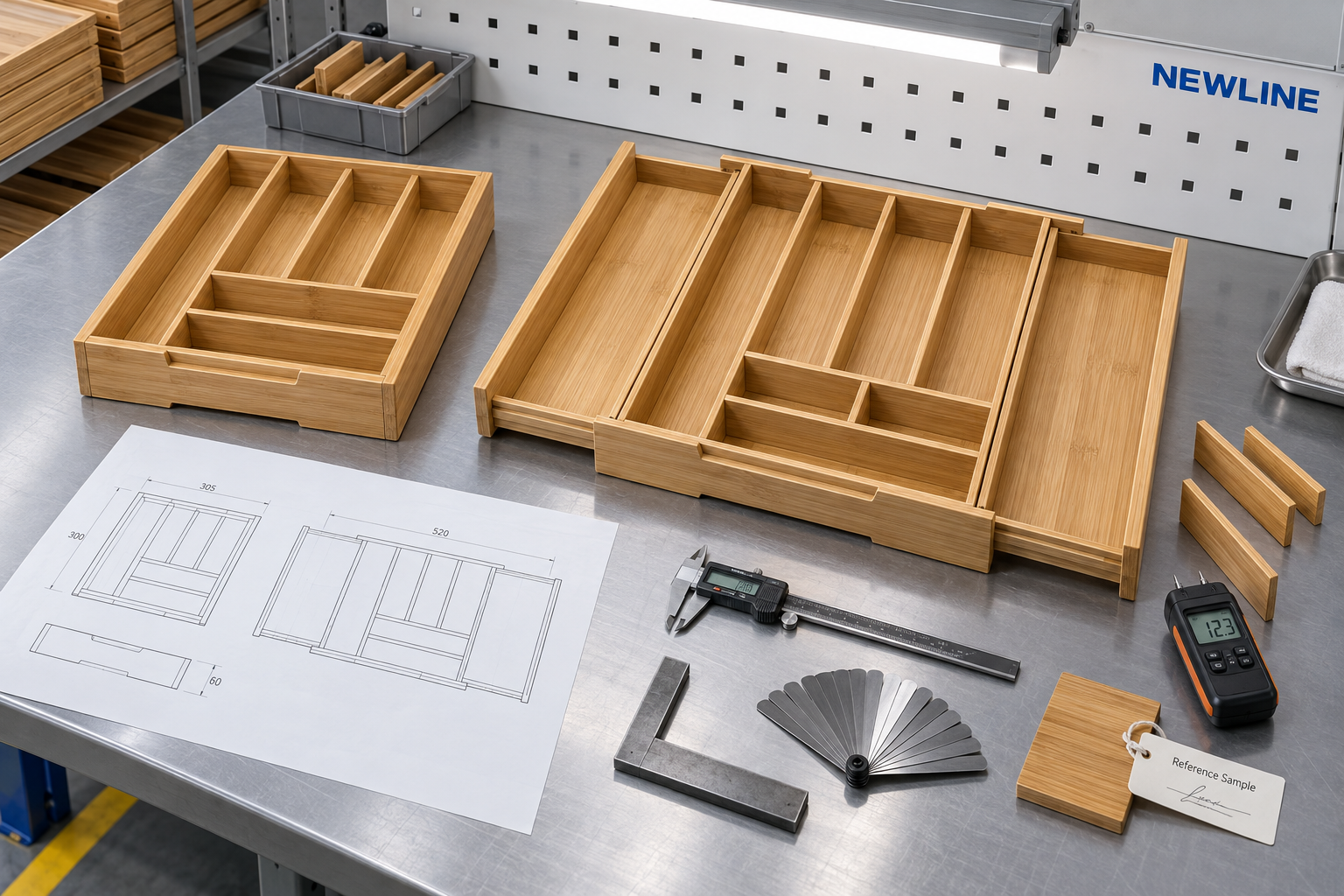
Separate appearance samples from engineering samples. An early prototype can confirm the drawer envelope and layout with a temporary finish. A later sample should use production-intent material, rail geometry, coating, pads and packaging. Label every sample with revision, date, purpose and known deviations.Without that record, a team may approve a beautiful prototype that cannot represent production.
Use real drawers at the compact, middle and wide ends of the intended range. Load utensils unevenly because customers rarely distribute weight symmetrically. Open and close the drawer. Pull the organizer by the wing, central wall and front edge. Remove and replace dividers. Wipe the finish using the proposed care method. Inspect the drawer for marks after movement.
Cycle testing should reflect the mechanism and risk. The point is not to choose an impressive round number. It is to repeat normal expansion, compression and drawer use enough times to reveal rubbing, loosening, pad migration or finish wear. Record the load, stroke, speed, environment and pass criteria so two samples can be compared. Recheck dimensions and play after cycling.
Approve the packed sample as carefully as the product. Confirm barcode position, label copy, languages, instructions, carton orientation, inner protection and master-carton quantity. Open it as a customer would. A pack that requires tearing across the visible product, sheds dust into compartments or hides the size explanation will create a weak first impression even if transit protection is adequate.
11. Create a product-specific quality plan
Final random inspection is only the last layer. Incoming material, first article and in-process controls should prevent the defects that cannot be economically corrected later. At receiving, verify the material identity, appearance range, critical panel dimensions, moisture method, coating or adhesive references, pads and cartons.During machining, check the features that control movement. At assembly, check squareness and overlap before finish or packaging hides the interface.
Define critical, major and minor defects in customer language. A sharp splinter, unsafe pinch condition or material substitution may be critical depending on the product and market. Binding expansion, an unstable wing, severe rocking, a missing divider or incorrect barcode can be major. Small cosmetic variation within a hidden zone may be minor. Do not let a generic factory list decide the classification for the buyer.
Sampling language can sound reassuring while leaving the decision undefined. If an AQL approach is used, name the lot, inspection level and acceptance limits, then keep safety or other agreed critical failures on a separate no-acceptance gate. ISO 2859-1 addresses sampling procedures for inspection by attributes; it does not invent the buyer's defect list. Write the organizer-specific checks first. Only then can a sampling table tell the inspector how many units to examine and what outcome follows.
Functional tests should use written methods: compact and maximum width, start and travel feel, safe overlap, divider fit, base rocking, pad adhesion, edge touch, finish appearance and packaging checks. Add destructive tests only where risk justifies them. The inspection report should include actual results, photographs, lot identity and disposition, not only a summary word such as “passed.”
| Control stage | Examples for an expandable organizer | Evidence to retain | Owner |
|---|---|---|---|
| Incoming | Bamboo construction, panel dimensions, moisture method, finish materials, pads and cartons | Lot record, supplier identity, readings and deviations | Incoming quality |
| First article | Finished dimensions, diagonals, expansion range, overlap, divider fit, appearance and pack-out | Signed report linked to drawing revision | Engineering and quality |
| In process | Rail and slot gauges, squareness fixture, sanding standard, coating application and cure | Check sheet, frequency and corrective action | Production supervisor |
| Final random inspection | Defect sampling, functions, labels, assortment and carton count | Inspection report with sampled results | Factory or independent inspector |
| Shipment release | Quantity, container condition, carton marks, documents and approved deviations | Release approval and loading evidence | Buyer and supplier |
12. Control packaging as part of the product specification
An expandable organizer is broad, relatively flat and vulnerable at corners, rails and exposed rims. The product can move inside a box even when the outer carton looks undamaged.The packaging brief should state the product condition, compact or secured width, surface protection, corner restraint, retail presentation, case pack, master-carton construction, gross weight, label positions and distribution route.
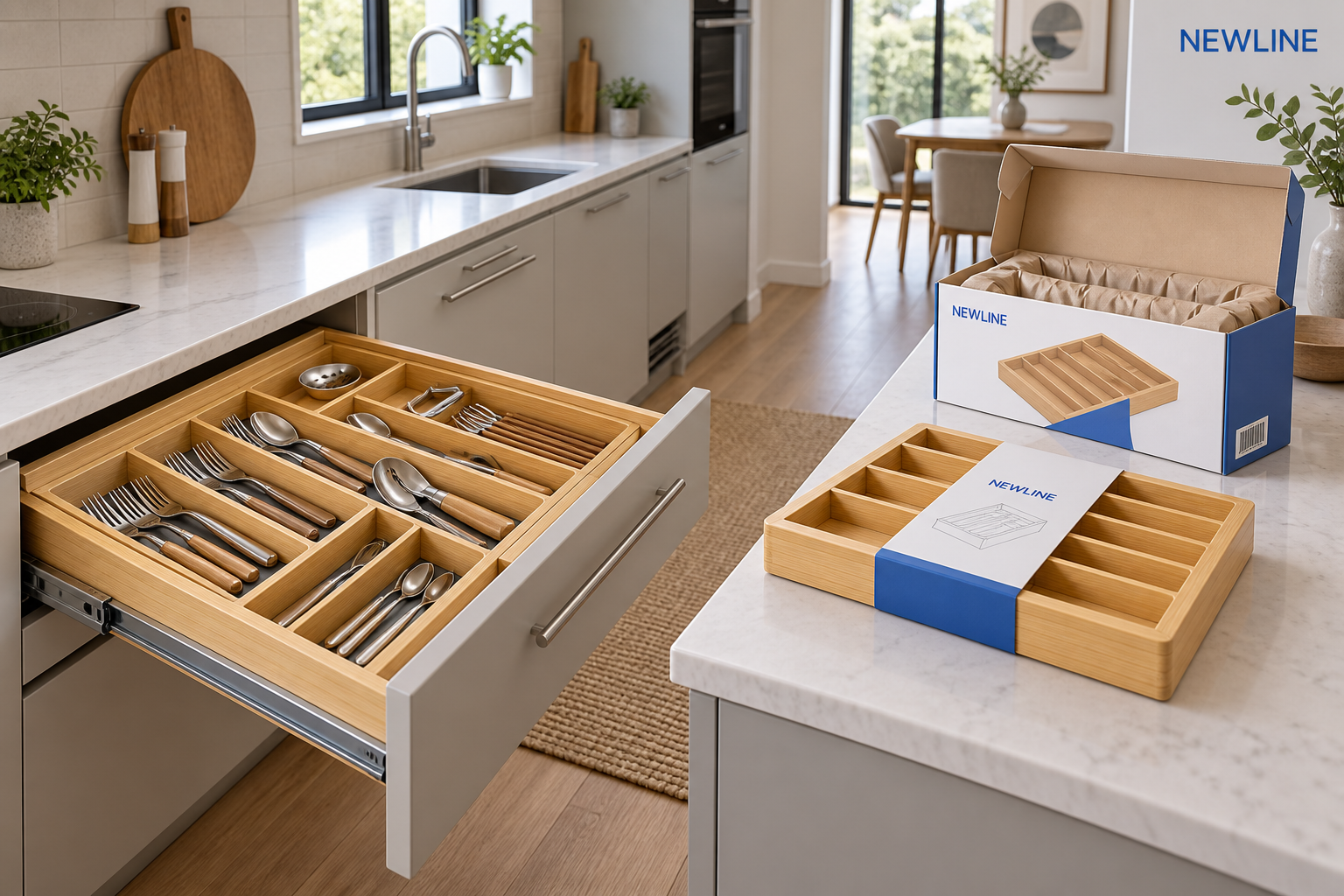
Choose protection from the damage mode. Paper wraps can protect finished surfaces from rubbing. Molded pulp or folded board can restrain corners and wings. A belly band can communicate dimensions while leaving bamboo visible, but it may provide little impact protection. A full color box protects and merchandises, yet printing minimums and revisions influence MOQ. Ask why each component exists and remove only what has no job.
Test the finished product in the finished pack. A substitute unit may have different mass, edge geometry or center of gravity. ISTA publishes packaged-product test procedures used to simulate distribution hazards; select a procedure with the retailer, laboratory or packaging specialist that matches the actual parcel, case or pallet route. A test name without correct product, pack level and conditioning is weak evidence.
Pack-out also changes landed cost. Record unit box dimensions, master-carton quantity, gross and net weight, carton cube and estimated container loading. A two-millimeter product change may allow a meaningful carton change; a thick protective insert may reduce damage but lower container utilization. Compare the cost of protection against expected claims and logistics, not against packaging price alone.
13. Understand what drives bamboo products MOQ
The published minimum should be explained, not simply accepted or negotiated. The bamboo products MOQ may come from panel purchasing, machining setup, coating batch, pad supplier, packaging print, carton conversion or production scheduling. Those constraints do not always have the same quantity. Ask for the product minimum, logo minimum, printed-pack minimum and economically sensible production batch separately.
A lower-risk pilot often standardizes invisible complexity. Use an existing material construction and finish while testing a new layout. Apply a label or neutral box before committing to large printed packaging. Share dividers, pads or carton footprints across related SKUs. These choices can reduce upfront exposure while preserving the customer-facing idea. They should be costed explicitly rather than promised as free flexibility.
Do not force a tiny production run if setup and yield make quality unstable. Sometimes the better pilot buys a normal production quantity but releases it in phases, limits artwork investment, or tests two size bands using common components. The right structure depends on cash, storage, demand evidence and the supplier’s process. Ask what will change when the order scales and which first-run costs will not repeat.
Forecast reorders honestly. A low opening quantity followed by uncertain timing can be harder to plan than a smaller annual commitment with scheduled releases. Share a range rather than one unsupported number. The manufacturer can then discuss raw-material reservation, packaging inventory and capacity.Commercial transparency helps prevent a first order from being quoted on assumptions that no longer apply to the second.
14. Compare quotations on the same product, pack and term
Normalize the offers before ranking suppliers. Each quotation should reference the drawing revision, material construction, finish, accessories, packaging, quantity, Incoterm and named place. Separate tooling, samples, testing, inspection, artwork and one-off charges. Record quotation validity and currency. If one offer excludes retail packaging or compliance testing, add the missing amount before calling it cheaper.
Ask for costed alternatives tied to specific changes. Examples include a different expansion range, shared component sizes, one color instead of two, neutral packaging, a simpler divider pattern or an alternative bottom construction. The supplier should state the unit-price effect, MOQ effect, timing effect and performance risk. A vague “cheaper version” makes future disputes likely.
Calculate landed cost with carton cube, freight assumptions, duty, inspection, damage reserve, warehousing and expected channel charges. For e-commerce, dimensional weight and parcel damage can matter more than container efficiency. For retail, case pack, label accuracy and shelf dimensions may dominate. A fractionally higher FOB price can produce a better margin when the organizer packs efficiently and arrives saleable.
Run a downside case. Add a packaging revision, extra inspection, moderate freight increase or launch delay. This is not pessimism; it shows whether the program has room for ordinary sourcing variability.The proposal that survives the downside case is often more valuable than the one optimized for a perfect first shipment.
15. Qualify the manufacturer with evidence linked to this project
A broad catalogue proves that a supplier can show products, not that it can hold the proposed organizer’s critical dimensions. Request examples with comparable expansion mechanisms, divider slots, thin walls, finish and pack-out. Ask which site performs panel work, machining, sanding, assembly, coating and packing. If any operation is subcontracted, record who approves changes and owns final quality.
Review a blank incoming check, first-article report, in-process sheet and corrective-action form. Pick one past issue, with customer details removed, and ask how it was contained and prevented from returning. A durable corrective action might change a fixture, gauge, parameter, drawing or inspection frequency. “Workers were reminded” is rarely enough.
Trace revision control. Drawings, bills of material, finish references, packaging artwork, labels and golden samples should carry the same product identity. A purchase order must point to the approved revision. When a change occurs, the notice should state the old and new requirement, reason, cost, timing, affected stock and approver.
Communication during quotation is a practical test. A manufacturer that raises the missing drawer height, asks how the wings should hold position and questions the packaging route is doing useful engineering. A fast “no problem” answer to every request can hide work that has not been understood.Specific questions usually reduce risk rather than slow the project.
16. Keep market requirements and claims tied to intended use
Compliance starts with the exact sellable item, not the category name. Material, finish, labels, claims and destination determine what belongs in the file. For European Union sales, begin with the official text of Regulation (EU) 2023/988 on general product safety. Work with qualified support to map identification, responsible economic operators, risk assessment, traceability and distance-sale information to the organizer and its actual offer.
Cutlery storage can tempt a team to copy the test language from a chopping board, but the two uses are not interchangeable. First describe what will realistically touch the organizer and for how long; only then review its bamboo, adhesive, finish and printed parts. A later serving piece needs its own assessment. For EU work, consult Regulation (EC) No 1935/2004, which sets the framework for articles intended or reasonably expected to contact food. Keep the evidence attached to the construction it actually covers.
For an FSC statement, use current chain-of-custody evidence and approved trademark handling. For recycled, plastic-free, compostable, carbon or biodegradability claims, define exactly what the claim covers and obtain appropriate evidence. “Eco-friendly” by itself is too broad. A precise material and packaging statement is easier for a buyer to substantiate and for a shopper to understand.
Retailer manuals may add label, chemical, packaging, drop-test or audit requirements beyond general regulation. Get those documents before final quotation and sample approval. The importer or brand remains responsible for confirming the requirements that apply to the exact product and market. The supplier’s role is to provide accurate construction data, records and production control.
Want a drawing and sample plan reviewed before tooling?
Share the internal drawer range, intended layout, destination market and packaging channel. We can identify the fit, tolerance and validation decisions that should be closed before a production quotation.
17. Connect a drawer organizer to a coherent storage collection
The organizer can lead a broader home-storage program when the shared design language is controlled. Edge radius, bamboo tone, handle shape, divider rhythm, blue-and-kraft packaging and care language can connect drawer, countertop and pantry products. That does not mean every item should use identical construction. A tray and an expandable organizer have different load and movement risks.
Buyers considering custom bamboo storage products manufacture should start with a platform brief. List common components, finishes, pack graphics and inspection terms. Then mark product-specific functions. Platform thinking reduces hidden variation and helps reorders, while clear exceptions prevent a common specification from weakening a high-risk item.
A custom wood kitchen products supplier may coordinate wood and bamboo versions where species character or a traditional appearance matters. Compare the construction and natural-variation limits rather than swapping the material name in the same drawing. Finish, moisture behavior, machining and cost can change.
If the assortment includes entertaining pieces, a wooden charcuterie board manufacturer must also manage intended food-contact use, usable serving area, finish, odor, warpage and gift packaging. Shared branding is helpful; shared unqualified compliance assumptions are not.
For private label wooden home products, keep one brand file for approved logos, colors, type, claims, warning style and packaging hierarchy. Each SKU still needs its own drawing, bill of materials, performance plan and pack-out. A collection should look related without hiding the engineering differences that protect quality.
18. Plan packaging and retail execution before the final sample
Good custom packaging for bamboo products begins with the route and the shopper. A retailer may want a visible bamboo surface and a compact size diagram. A marketplace seller needs robust parcel protection and unambiguous dimensions. A wholesaler may need mixed-SKU labels and master cartons that can be handled without opening every case. Define the channel first, then choose the box, sleeve, insert and labels.
The packaging artwork should answer three fit questions: the compact dimensions, the working range and how the customer should measure the drawer. Use an internal-drawer diagram, not a cabinet-front measurement. Show the organizer before and after expansion without implying it stretches beyond the approved range. If dividers move, show the approved positions and avoid configurations that the actual parts cannot achieve.
When selling bamboo products for retailers, build a launch file containing final photographs, dimensional copy, material wording, care, warnings, case pack, carton measurements, barcode verification and the approved golden sample. The online listing and retail box must describe the same item. A mismatch can create returns even when the product is well made.
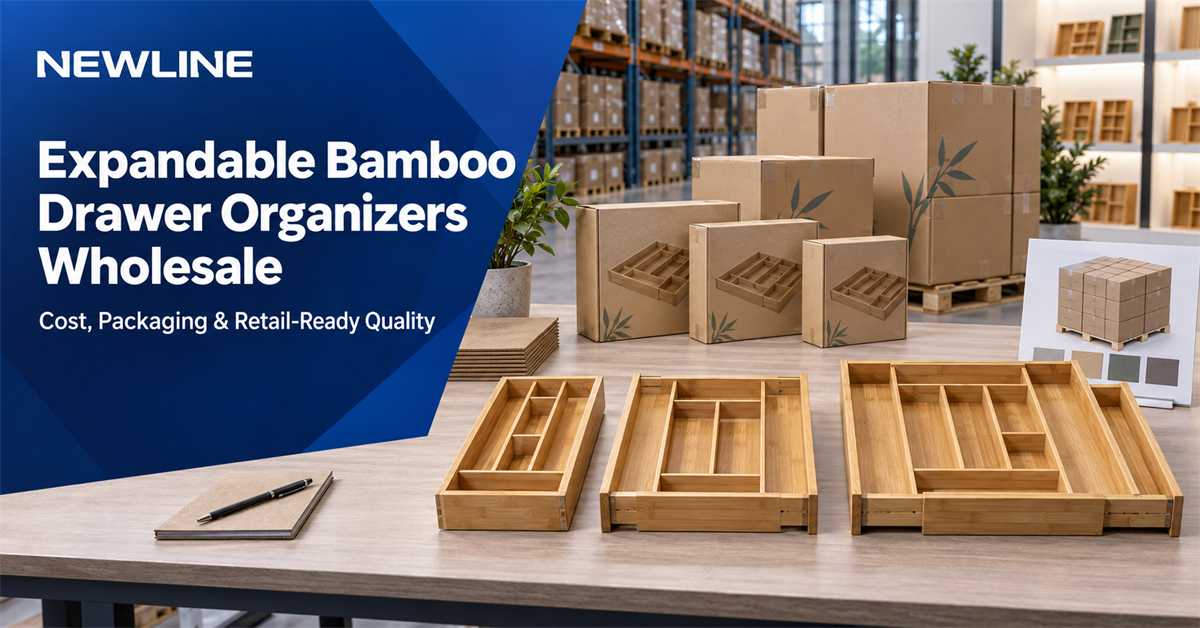
A wholesale buyer exploring expandable bamboo drawer organizer wholesale options should compare pack cube and reorder logic alongside the organizer itself. A model that fits more drawers is commercially useful only if the size claim is accurate, the mechanism holds up, and the pack reaches customers without damage.
19.Use a gated OEM process from brief to reorder
Gate 1: commercial brief. Name the person using the organizer and the drawers it must serve. Add the selling channel, retail position, credible annual range and launch window. On the same page, note the failures the brand will not accept, who owns drawings and artwork, and what remains undecided. The open boxes matter: they stop an estimate from quietly becoming an approved requirement.
Gate 2: engineering definition. Approve the drawer-fit dataset, size architecture, expansion cross-section, finished dimensions, critical tolerances, materials, finish and packaging concept. Request costed alternatives for unresolved choices. Do not commit to final tooling or artwork while the safe overlap or working width is still unclear.
Gate 3: prototype verification. Test production-intent samples in real drawers. Load, cycle, wipe, remove dividers and check touch points. Open the retail pack. Record results and deviations in a punch list. A sample is not approved because the meeting ended; every material point needs an owner and disposition.
Gate 4: golden sample and production file. Freeze the drawing, bill of materials, finish, limit samples, artwork, pack-out, defect list and functional methods. Label the signed reference sample. State which changes require buyer approval. Release mass production only against this package.
Gate 5: first article and pilot. Inspect early units made with normal production tools and people. Check capability at minimum and maximum widths.Review yield, actual cycle time, packaging and documentation. A pilot should have agreed criteria for scale, correction or stop.
Gate 6: shipment and reorder learning. Compare final inspection, on-time performance, carton damage, retailer feedback, returns and customer fit comments. Separate brief errors from process errors. Update the specification and online copy before the reorder so the second production run benefits from actual market evidence.
20. Ten high-intent buyer FAQs
| # | Procurement question | Practical answer | What to send or request |
|---|---|---|---|
| 1 | What information produces an accurate expandable organizer quotation? | Provide intended use, internal drawer width range, depth, height, compartment layout, material direction, finish, logo, packaging channel, volume tiers, market and launch date. Separate fixed requirements from open design decisions. | Drawer measurements, reference photos, target quantity, target pack and compliance brief. |
| 2 | What is the MOQ for a custom bamboo drawer organizer? | There is no universal number. Material, machining setup, finish, components, printed packaging, carton conversion and scheduling can each create a different minimum. Ask the supplier to identify every driver and cost a pilot route. | MOQ by product, color, logo and pack, plus reorder assumptions. |
| 3 | How should buyers verify that the organizer fits the target market? | Build a dataset of usable internal drawer dimensions, then test compact, nominal and maximum widths in representative drawers. Include clear height and obstructions, not only width. | Fit-coverage table, working-range drawing and test results. |
| 4 | Which tolerances are most important? | Prioritize compact width, safe maximum width, overlap, rail clearance, squareness, divider-slot fit, base flatness and carton fit. Use tighter limits only where variation affects function or appearance. | Dimensioned drawing with datums, methods and finished-condition limits. |
| 5 | How is expansion quality tested? | Record start force or feel, smooth travel, noise, side play, holding behavior, safe overlap and performance under uneven load. Cycle the unit and repeat the checks after appropriate conditioning and transport. | Written cycle method, load, stroke, environment and pass criteria. |
| 6 | Can size, dividers, finish, logo and packaging all be customized? | Usually yes, within manufacturable limits. Each change can affect tooling, test scope, yield, MOQ, unit cost and lead time. Approve a controlled revision rather than changing details through chat messages. | Options matrix showing cost, timing, MOQ and risk for each change. |
| 7 | How should natural bamboo color variation be controlled? | Define visible zones and approve representative high and low limit samples under agreed lighting.Do not rely on one edited photograph or an undefined grade name. | Signed range board, surface-zone map and cosmetic defect list. |
| 8 | What packaging is suitable for retail and e-commerce? | Retail packs need clear fit communication and shelf presentation; e-commerce packs need single-parcel restraint and impact protection. Test the finished unit in the exact pack used for sale. | Pack dieline, unit and master dimensions, barcode, labels and route-specific test plan. |
| 9 | What should a pre-shipment inspection include? | Check quantities, identity, critical dimensions, expansion, overlap, divider fit, rocking, edges, finish, odor, pads, artwork, barcode, pack-out and carton marks using an agreed sample plan and defect list. | Inspection protocol, lot definition, report format and disposition process. |
| 10 | What should happen if inspection or arrival reveals a defect? | Agree containment, sorting, rework, replacement, credit and root-cause procedures before the order. Evidence should identify the affected lot and distinguish an isolated escape from a systemic process problem. | Claim timeline, evidence requirements, remedy terms and corrective-action format. |
21. A decision-ready RFQ checklist
- The target user, drawer population, channel and price position are named.
- Compact, nominal and maximum working dimensions use clear datums.
- The expansion cross-section shows rail clearance, overlap, stops and load support.
- Critical tolerances protect fit, movement, divider assembly and carton restraint.
- Bamboo construction, hidden materials, finish, pads and adhesives are recorded.
- Natural variation is controlled with zones and physical limit samples.
- Cleaning, care and marketing claims match the validated use.
- Prototype tests use real drawers, real utensils, uneven loads and repeated cycles.
- The golden sample, drawing, bill of materials, artwork and inspection plan share one revision.
- Incoming, first-article, in-process and final checks address product-specific failures.
- Packaging protects the wings, corners and visible finish for the actual route.
- MOQ drivers, quotation exclusions, tooling and sample terms are understood.
- Landed cost includes cube, freight, inspection, damage and channel charges.
- Market evidence and sustainability claims are tied to the exact construction.
- Inspection remedies and reorder-learning responsibilities are agreed before shipment.
22. Send a brief that a manufacturer can answer
A useful first inquiry does not need a finished CAD file. Send the product job, the smallest and largest usable drawer measurements, long-tool needs, preferred number of compartments, a target finish, destination market, target retail position, expected volume range and packaging route. Add photographs of any current product and explain what should improve. Mark unknowns honestly.
Newline can use that information to review size coverage, identify the critical mechanisms and propose a sample path.The response should make assumptions visible: what is standard, what needs new engineering, which decisions change MOQ, and what evidence will be ready before production. That creates a quotation connected to the product you intend to sell.
Request a Bamboo Drawer Organizer Quote
Include drawer measurements, target market, preferred layout, annual quantity range, launch window and packaging channel. If you have an existing organizer, tell us what customers like and what must be corrected.
Authoritative references used for this guide
- European Union, Regulation (EU) 2023/988 on general product safety.
- European Union, Regulation (EC) No 1935/2004 on materials and articles intended to come into contact with food.
- Forest Stewardship Council, Chain of Custody Certification.
- International Safe Transit Association, packaged-product test procedures.
This guide is a procurement and product-development framework, not legal advice or a substitute for product-specific testing. Requirements should be confirmed for the final construction, claims, destination market and selling channel.