Commercial sourcing guide for retailers, importers, wholesalers and private-label teams
Expandable Bamboo Drawer Organizers Wholesale: Cost, Packaging and Retail-Ready Quality
The buyer's short answer
The commercial test for an expandable bamboo drawer organizer wholesale program is straightforward: can the buyer explain the fit, earn the planned margin and deliver the item intact? Put every quote against the same drawing and the same named Incoterm. Then expose the differences—compact and working dimensions, construction, finish, accessories, unit pack, case pack, cube, validation, inspection, tooling and exclusions. A low unit price is not cheaper when the supplier has priced a different product.
For a first order, reduce risk through a deliberate assortment rather than the broadest possible catalog. Choose a hero size with strong fit coverage, one clear value proposition and a pack that works for the channel. Cost a pilot quantity and realistic reorder quantity separately. Approve product, artwork and packed sample through gates; then use sell-through, return reasons, review language and replenishment data to decide whether the next order should scale, change or split into a second size.
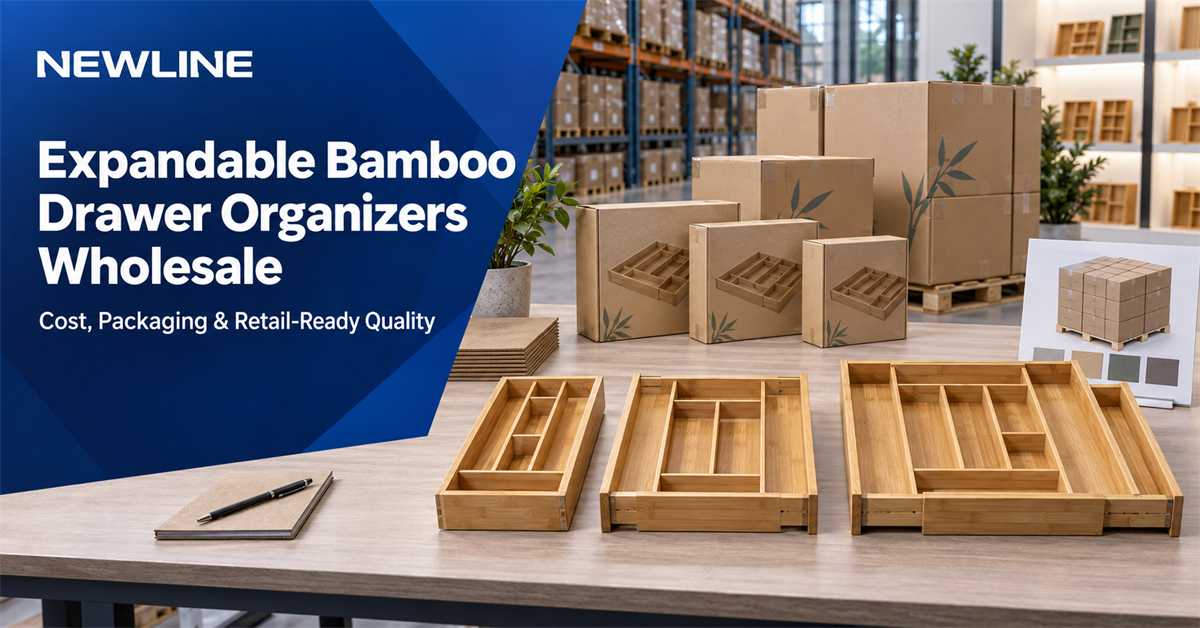
The sample on a meeting table is only the beginning. Wholesale performance is decided later: when shoppers interpret the size claim, warehouse teams handle cases, parcels absorb impacts, cartons consume freight space, and replenishment orders must match the approved unit without a new round of problem solving.
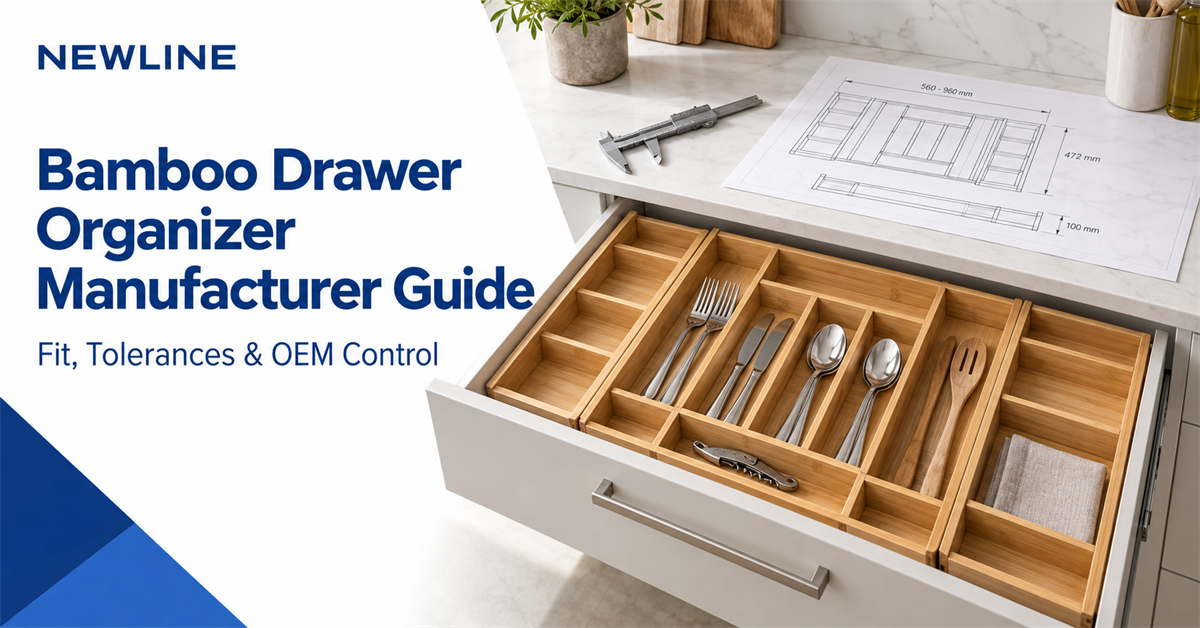
Keep this expandable bamboo drawer organizers wholesale guide beside the quotation sheet. It is meant for the commercial decisions that are easy to miss when a sample looks good: how much of the market the size covers, which SKUs deserve stock, what the packed cube costs and what happens on reorder. Engineers will still need a deeper file. For sliding clearance, tolerance and test detail, continue with our bamboo drawer organizer manufacturer guide.
Need a comparable wholesale quotation?
Send the target drawer range, intended channel, volume tiers, destination, packaging format and target launch window. Newline can identify missing cost assumptions before samples or artwork begin.
1. Start with a retail proposition, not a supplier catalog
Before requesting prices, write one sentence that a shopper can understand. For example: “An expandable bamboo cutlery organizer that fits internal drawer widths from the confirmed compact dimension to the confirmed working maximum, with separated space for daily flatware and longer tools.” The final figures must come from approved samples and drawings. The sentence forces the team to name the use, fit promise and practical benefit rather than relying on broad words such as premium, natural or versatile.
Define the channel because it changes the offer. A home-improvement retailer may need shelf communication that helps shoppers measure correctly. A marketplace seller needs image-led fit instructions, accurate dimensions and parcel protection. A distributor may prefer neutral packaging, mixed product orders and predictable case packs. A gift retailer may accept a higher packaging cost for presentation. One organizer cannot be evaluated commercially until the route to the buyer is clear.
Record the primary customer and the drawer problem. A family separating a large cutlery set has different needs from a city apartment user organizing one compact drawer. A professional home organizer may value modularity and predictable dimensions; a gift customer may value finish and unboxing. The product should not try to solve every storage problem. A disciplined promise makes photography, packaging and paid-search copy more credible, while reducing features that add cost without improving the intended use.
Define what will not be claimed. An organizer designed for dry interior use should not drift into waterproof language. A renewable raw material does not make every finished item automatically low-impact. A fit range tested in a selected drawer sample should not be called universal. Clear boundaries protect the brand and make supplier testing more focused. They also help customer service answer questions consistently.
2. Choose the size architecture from measured market coverage
Expandable organizers earn their value by covering multiple drawers, but width alone does not define fit. Usable depth, clear height, corner radii and internal hardware matter. Gather internal measurements from representative kitchens in the target market. If direct research is limited, combine retail partner feedback, current product returns, installer input and measured competitor samples. Mark every assumption so it can be validated during the pilot.
Plot the observed internal widths and ask how much of the likely market one compact-to-expanded range covers. The most extreme drawer should not dictate the first SKU if doing so makes the product bulky, unstable or expensive for most buyers. A central range with honest communication can perform better than an aggressive “fits all drawers” claim. A second size can be introduced later if the data shows a meaningful uncovered segment.
Depth and height often create silent returns. A wide organizer may fit between the sides but prevent the drawer from closing because stacked utensils sit above the wall. A long model may hit the back profile or a divider built into the cabinet. Packaging and online content should show all three external dimensions in compact and expanded states, explain that the customer must measure the usable interior, and identify any extra clearance needed for operation.
Do not let the farthest point a wing can be pulled become the advertised size. Ask for the largest working width that still leaves sound overlap and support under an uneven load. If the mechanism travels beyond that point, add a stop or make the limit unmistakable. Place samples in real drawers near both ends of the range and one in the middle. Keep photographs, measurements and observations with the approved product file.
| Range decision | Commercial advantage | Main risk | Evidence before launch |
|---|---|---|---|
| One hero expandable size | Simple inventory, content and replenishment | May leave narrow or extra-wide drawers unserved | Measured fit-coverage dataset and honest size copy |
| Two expandable size bands | Better fit with less exposed wing area | More forecasting, cases and listing complexity | Demand estimate by size and clear customer selection guide |
| Fixed entry size plus expandable premium | Creates a visible good/better choice | Benefits may be confused if layouts are too similar | Price ladder, feature hierarchy and channel-specific merchandising |
| Organizer plus modular accessories | Supports basket building and coordinated storage | More components, packs and stock dependencies | Compatibility matrix, bundle logic and component replenishment plan |
A fit study should end with a selling decision. Choose the hero SKU, state how much of the measured drawer sample it covers, and say plainly who falls outside that range. That record is vital when comparing expandable bamboo drawer organizers wholesale: two suppliers may use the same product name while one has quoted a narrower unit or a smaller safe overlap. The chosen limits also give packaging and customer service a truthful message.
3. Design the assortment around choice that buyers can explain
Retailers need meaningful choices, not a wall of nearly identical bamboo. Begin with the hero model and define each additional SKU by a distinct job. A narrow model might address apartment drawers. A deeper model might hold cooking utensils. A premium model might use removable dividers, a concealed expansion system or upgraded packaging. If the difference cannot be explained in one line, it will be difficult to forecast and difficult for shoppers to value.
A good-better-best ladder can use size, layout, finish, accessories and pack presentation. The entry item still needs sound edges, stable construction and truthful dimensions. The premium tier should add visible utility or a meaningful experience, not just hidden cost. Ask the supplier to cost the differences separately so the team can see whether a feature adds margin opportunity or only complexity.
Color variants can appear easy, yet a stain or painted edge may create its own material batch, coating setup, approved standard, label, photography and inventory. Treat color as another SKU. For a first season, a strong natural bamboo direction with coordinated blue or neutral packaging may be more manageable. Add color after demand proves that it earns its operational burden.
Cost a bundle as a new SKU. Dividers, labels or companion boxes may improve the offer, yet each piece can be missed, damaged or supplied on another schedule. Find out where final packing occurs, who counts the components and whether a spare can be sent without replacing the full unit. The bundle needs one useful story for the shopper. Combining unrelated slow stock is not that story.
4. Freeze a quotation specification before comparing prices
A price is not comparable until the underlying product is comparable. This is especially important when sourcing expandable bamboo drawer organizers wholesale, because a similar hero image can hide different working ranges, panel thicknesses and packs. Prepare an RFQ sheet with overall dimensions, compact and working-expanded width, wall and panel construction, compartment layout, finish, feet or pads, logo, labels, unit packaging, master carton, case pack, tests, inspection, quantities, destination and requested trade term. Attach a numbered drawing or marked reference photographs and give the file a revision.
Request at least three quantity tiers that reflect a pilot, a likely reorder and a scale scenario. State whether the quantity is per SKU, per finish, per artwork and per shipment. Ask which cost elements are included: samples, tooling, printed materials, testing, inspection support, export packing, pallets, document fees and inland delivery. The supplier should identify assumptions rather than leaving blanks that later become surcharges.
Use one Incoterm and named location for comparison. An FOB number and an EXW number are not side-by-side offers. Currency, payment timing, quotation validity and material-price review rules also matter. If freight is volatile, keep the product cost and logistics estimate visible as separate lines. This prevents a temporary freight movement from being mistaken for a manufacturing advantage.
Do not invite silent cost reduction by sending only a competitor photo and target price. Ask the supplier to propose options with consequences. A thinner side may lower unit cost but increase movement. A simpler pack may reduce cube but expose corners. A smaller expansion range may improve stability and cost while covering fewer drawers. Decision makers need the cost delta, performance effect, MOQ effect and schedule effect for every option.
| Quotation line | Supplier A | Supplier B | Buyer normalization question |
|---|---|---|---|
| Product revision | Drawing R2 | Photo reference only | Are both prices based on identical finished dimensions and construction? |
| Quantity basis | Per SKU | Total mixed order | Can colors, artworks or models share the stated minimum? |
| Packaging | Printed retail box and master carton | Bulk protective pack | What reaches the shopper, and what validation is included? |
| Quality | Defined inspection and function checks | “Standard QC” | Which characteristics, sample plan and reports are included? |
| Trade term | FOB named port | EXW factory | Which inland, export and terminal costs must be added? |
| One-time costs | Listed separately | Not stated | Are samples, tooling, tests, plates and artwork setup included? |
| Lead time | After sample and artwork approval | After deposit | What event starts the clock, and which approvals are assumed complete? |
5. Build landed cost from the packed unit outward
Use FOB as one line in the model, not as the final answer. Start with the measured packed unit and carton. Add the factory price, an allocation for tests and inspection, uncovered origin charges, ocean or air freight, insurance, duty, customs work, destination handling, drayage, receiving and any channel preparation. Date the freight, duty and exchange assumptions. Six months later, the team should be able to see which number moved instead of blaming the product cost.
A drawer organizer is usually light for the space it consumes, so cube can quietly dominate freight. Measure the sellable pack and master carton, record case quantity and both weights, and calculate cubic meters per unit. Check the factory's loading estimate against pallet rules, mixed-SKU reality and space that cannot be used around doors or irregular stacks. Treat the figure as planning data. A forwarder still has to confirm the actual booking and load plan.
Packaging cost and freight cost must be evaluated together. A larger box may protect the product but reduce container utilization. A compact sleeve may improve cube but expose sliding wings to impacts or moisture. A knock-down idea may save space and create assembly complaints. Test at least one value-engineering option at packed-sample stage. The best answer minimizes total expected cost, including likely damage and returns, rather than one line in the quotation.
Put launch charges where decision makers can see them. Tooling, laboratory work, dielines, plates, photography and setup still consume cash when they sit outside the unit quote. The brand may charge them to the pilot, spread them over a forecast or hold them as launch investment; that is an accounting choice. Show both first-order cash and mature reorder margin, because hiding one-time costs inside an optimistic volume makes the pilot look healthier than it is.
Model at least three outcomes: expected, downside and scale. The downside case can use lower sell-through, a higher freight rate or a modest returns allowance. The scale case can use a larger reorder tier and improved loading, but only if those benefits are documented. A wholesale program should remain viable without assuming every optimistic variable arrives at once.
6. Treat MOQ as a map of constraints, not one fixed number
There is no universal bamboo products MOQ. Material preparation, machining setup, coating batch, hardware purchase, printed packaging, carton conversion and production scheduling can each create a minimum. Ask the supplier to name the binding constraint for the quoted program. That answer reveals which customization can be changed without redesigning the product.
Separate product MOQ from packaging MOQ. A manufacturer may be able to produce a modest natural-finish batch while the custom printed box supplier requires a larger run. Options may include a stock carton with a printed sleeve, digital labels, shared structural dielines across SKUs, or neutral packaging with market-specific stickers. Each option affects appearance, labor, compliance copy and reorder inventory, so the tradeoff should be explicit.
Mixed-SKU orders are possible only where processes and materials genuinely overlap. Two organizer widths may share panels, finish and packaging board, yet they still need separate machining, assembly, labels and inspection. Ask which minimum applies per model, per color, per logo and per pack. Do not assume the total purchase value allows any combination. Conversely, do not accept a high minimum without understanding what actually drives it.
A pilot route can reduce risk, but it is not simply a tiny production order. Samples and early batches often carry more supervision, setup and unit cost. Define what the pilot must prove: fit coverage, packaging survival, on-time execution, consumer comprehension, return rate or replenishment demand. Agree which specification will remain unchanged if the pilot scales and which points may be revised after evidence arrives.
MOQ negotiations are strongest when paired with a credible forecast. Share the intended pilot, launch window, reorder trigger and annual scenario without turning an estimate into a promise. A supplier can then consider material reservations, shared production windows or packaging strategies. The buyer gains more from a feasible ramp than from a nominally low minimum that cannot support repeatable cost or timing.
7. Set a price ladder that protects both margin and product integrity
A useful cost meeting begins with the shelf price and a calculator, before anyone falls in love with a sample. Deduct the channel margin, likely promotions, freight, duty, fulfillment, returns and overhead. What remains is the landed-cost boundary. Ask the supplier to sketch two or three constructions inside it and explain what changes. If the math still fails, remove a feature or rethink the pack in plain sight. Hidden reductions in wall thickness or inspection merely send the bill forward to the returns desk.
Identify “must keep,” “flexible” and “remove first” features. Must-keep items may include safe overlap, stable walls, smooth edges, confirmed finish and essential packaging protection. Flexible items might include a non-critical divider, decorative groove, inner-print color or premium insert. Remove-first items are features that do not support the promise. This hierarchy enables value engineering without damaging the reason the product exists.
Volume discounts should be tied to real drivers: longer runs, better material purchasing, packaging efficiency, consolidated shipment or reduced setup. Ask what changes between tiers. A suspiciously steep reduction may assume a construction change, a different inspection level or unsupported forecast. Keep the approved specification identical unless a revision is formally reviewed and sampled.
Promotion economics need their own scenario. If the retailer expects temporary price reductions, include funding, extra volume, lead time and packaging implications early. An organizer that only earns acceptable margin at full price may be weak for promotion-led channels. A stable everyday value proposition can sometimes outperform a premium pack with constant discounting.
8. Approve packaging as part of the sellable product
Packaging performs four jobs: it protects the organizer, communicates fit and value, satisfies channel operations, and delivers required information. Begin with a packaging brief, not a dieline. State where the unit will be sold, whether the shopper can touch it, how cases move through the distribution center, whether single units ship by parcel, and which faces are visible on shelf or online.
The front panel should communicate the primary benefit and a truthful visual. Size communication must distinguish product dimensions from required drawer dimensions. Use a clear compact-to-working-range diagram and ask the customer to measure the inside of the drawer at the relevant height. The back or side can show how to expand the product, how compartments are intended to be used and how to care for the finish.
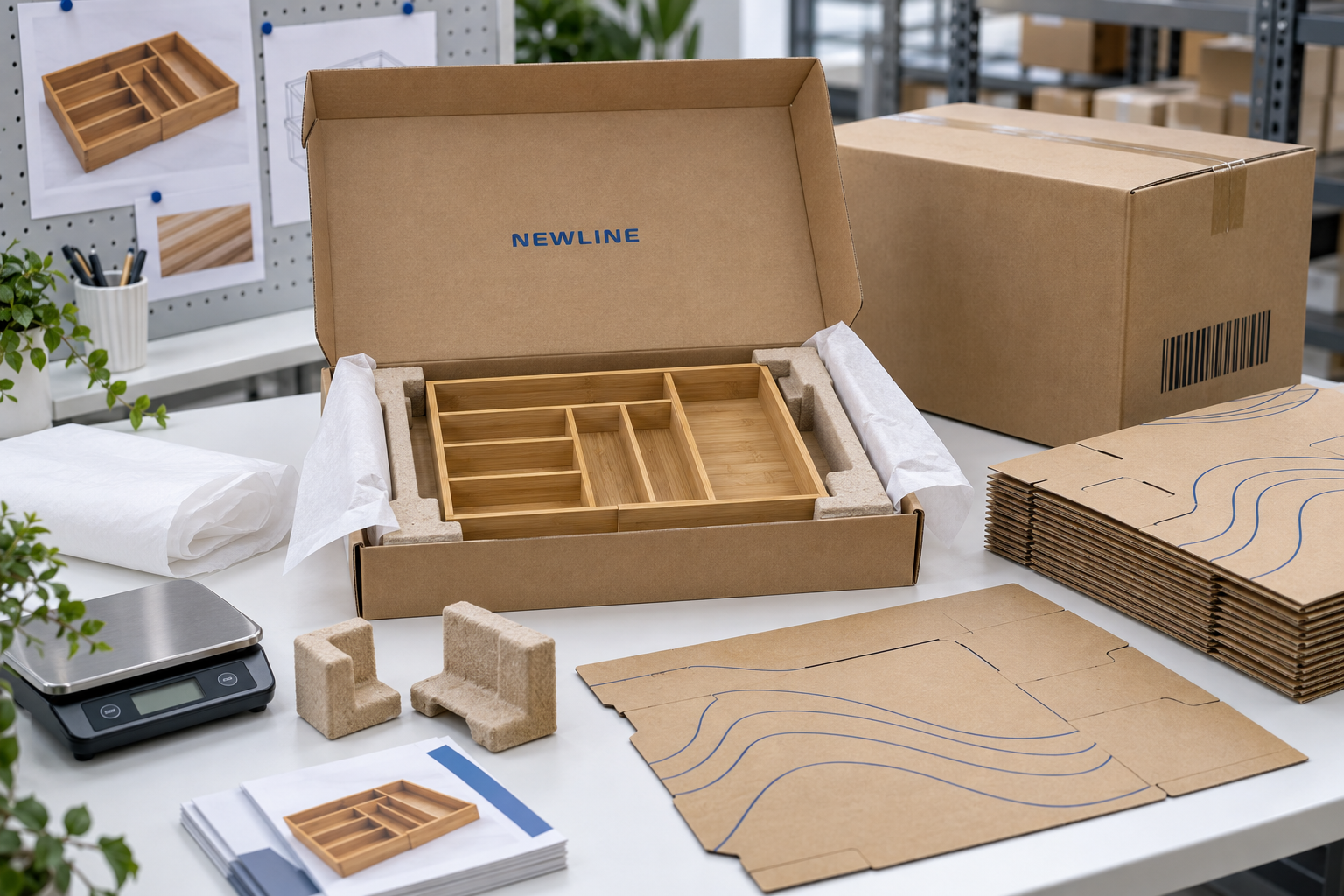
Protect moving parts without making unpacking frustrating. Side wings can shift and rub against the body. Exposed corners can dent or puncture board. Printed sleeves can scuff against a textured surface. Restraint, tissue, paperboard supports or other protective components should address a named failure mode. Avoid adding material without evidence; unnecessary inserts increase cost, cube and disposal burden.
For a custom packaging for bamboo products program, control structural and graphic files separately. Give each dieline and artwork a revision. Confirm dimensions using the production-intent organizer, not a rough substitute. Proof barcode content and scanning, legal text, country of origin, material statements, care, warnings, languages and retailer-specific labels. Approval should record who checked each layer and which file is released for printing.
9. Validate packaging for the distribution route
“Export standard” tells a packaging engineer almost nothing. Sketch the route from the packing bench through factory stacking, truck or container, unloading, a distribution center and either store replenishment or parcel delivery. Circle the moments when the organizer can fall, be crushed, rub, get damp or be struck by its own loose accessory. Now the pack has a job to do. Each insert or restraint should answer one of those risks and have a clear pass condition.
Test the final production-intent product in the final packaging. A sample made from different material thickness, without finish, or with temporary inserts can produce misleading results. Define the sequence, orientation, conditioning, drop heights or vibration profile, number of samples and pass criteria appropriate to the route. The International Safe Transit Association publishes packaged-product test procedures that can help buyers and packaging professionals select a suitable protocol. Selection and interpretation should reflect the actual distribution system.
A pass is more than an unbroken outer carton. Inspect expansion movement, squareness, finish, edges, pads, dividers and retail-pack appearance after the test. A product can remain functional while arriving with rub marks that cause a retail rejection. Conversely, a slightly marked master carton may be acceptable if the unit and selling pack remain within the agreed standard. Write the acceptance level for each layer.
Run a root-cause review when a test fails. Adding foam everywhere may hide the real problem and increase volume. The better action could be locking the wing, changing orientation, reinforcing one corner, moving a divider, adjusting the carton clearance or changing how cases are stacked. Retest the revised pack and record the version. Do not approve a diagram without a tested physical pack.
Keep a packed reference sample and a loading photograph. Production teams need to see the direction of the organizer, location of protection, quantity of inserts and position of labels. Warehouse and inspection teams need the same evidence. A simple pack-out instruction can prevent expensive variation that is invisible in the artwork PDF.
10. Calculate carton cube and handling before signing the order
Use measured packed dimensions, not an early estimate, in the logistics model. Calculate cubic meters per master carton and per sellable unit. Compare case-pack options against weight limits, manual handling, pallet footprint, container use and retailer receiving rules. A high case pack can improve board efficiency but create an awkward or heavy carton. A low case pack can simplify handling while increasing cartons, labels and receiving events.
Expandable organizers do not always nest efficiently because walls, rails and dividers occupy a fixed envelope. Avoid forcing nested contact that scratches visible faces or stresses the sliding system. If products can be nested safely, define the separator, orientation and extraction method. If they cannot, accept the true cube and improve other parts of the case design.
Calculate gross-weight tolerance because natural-material products and corrugated board vary. The carton marking, booking and retailer file should use a realistic value. If palletization is required, check overhang, height, pattern stability and label visibility. If floor loading is used, protect against uneven stacks and confirm unloading constraints. The lowest cubic figure is not helpful if it creates damaged goods or unsafe handling.
For mixed containers, rank cartons by crush sensitivity and weight. A bamboo organizer case should not be treated as an indestructible block merely because the product is rigid. Heavy cartons above it can transfer load to product walls if the pack clearance and compression strength are poorly matched. Ask how the supplier plans the load and how deviations are documented when the final mix changes.
11. Build retail information that prevents avoidable returns
Product information is part of quality because it shapes whether the item is chosen and used correctly. The primary image should show the actual organizer, not a configuration that cannot be achieved. Dimension graphics should distinguish compact product size, working expanded size and required drawer space. Show the measurement points. If depth or height limits use, make them as visible as width.
Use a sequence of images that answers the shopper's real questions: What fits inside? How does it expand? Will it stay organized when the drawer moves? What does the material look like close up? How should it be cleaned? What arrives in the box? A photograph of a perfectly styled drawer is useful, but it cannot replace a diagram and accurate written dimensions.
Before writing the care panel, try the sort of cleanup an owner will attempt after breakfast. Wipe a finished unit, leave a small spill briefly, dry it and inspect the surface. The result should drive the wording. If soaking or a dishwasher is outside the design, say so without euphemism. Add a close photograph for any loose pad or divider. That practical guidance is what a shopper needs when opening the box—and when water first reaches the drawer.
Customer service should receive a practical answer sheet, not only the sales listing. Include the exact measurement points, working range, component count, material description, care notes and lot-identification route. Keep “Will this fit?” questions separate from “This did not fit” cases. The first pattern often exposes missing content; the second needs the drawer measurement, product measurement and batch before anyone decides whether the fault lies in use, copy or production.
For cross-border listings, translation should preserve units, warnings and limitations. Do not rely on automatic translation for safety or material claims. Keep one approved source-text file and record market variants. When the product or packaging changes, update every listing and instruction that depends on the old revision.
12. Plan barcodes, labels and marketplace data as production inputs
A barcode is not a decoration added after box approval. Decide which entity owns the identifier, which symbology and print size the channel requires, where it will be placed, and how quiet zones and contrast will be protected. Verify the encoded number against the buyer's item master, then scan printed production samples rather than only a digital proof. The GS1 barcode standards overview is a useful authoritative starting point; retailer implementation rules still apply.
Label content should be mapped by responsibility. Product identity, dimensions, net quantity, material, care, origin, importer or responsible-person details, recycling marks, warnings and certification marks can have different owners and evidence. The correct requirements depend on destination, channel, claims and product design. Engage qualified compliance support rather than copying a competitor's package.
Marketplace setup needs a structured data sheet. Record title, approved bullet points, dimensions, weight, package dimensions, included components, color, care, material description, country of origin, model number, barcode and image references. Keep claims evidence beside the corresponding text. A spreadsheet with controlled fields prevents sales teams from inventing new superlatives under launch pressure.
Lot or date identification can support traceability even when the product is simple. Decide where it appears and how it links to production and inspection records. The mark should remain legible without distracting from the retail design. If a retailer or regulation requires specific traceability information, include it before artwork release and verify it in final inspection.
13. Convert quality expectations into a buyer-approved control plan
“Good quality” cannot be sampled. Define critical, major and minor defects for the actual organizer. Critical concerns can include hazards or noncompliance. Major defects can include expansion failure, unsafe overlap, wrong dimensions, rocking, sharp edges, severe finish defects, missing components, wrong barcode or packaging that does not protect the item. Minor defects can include small cosmetic variation within agreed limits. The exact classification should reflect product and market risk.
Agree the lot definition, inspection timing and sampling method before production. A buyer may use an AQL-based plan or another justified approach, but the numbers alone do not define quality. The checklist needs measurement points, instruments, functional methods, reference samples and pass criteria. Identify which items are checked on every unit in process and which are sampled at final inspection.
First-article and in-process checks are valuable for characteristics that cannot be fixed after the whole batch is complete. Rail geometry, divider slots, squareness, color range and packaging fit should be reviewed early. Final inspection then confirms identity, quantity, workmanship, function, artwork and pack-out. Keep photographs and measured results, not just a pass stamp.
Natural material variation needs boundaries. Approve a range for visible tone, strip contrast, small filled areas and grain character. Divide the product into visible and concealed zones. Inspect under agreed lighting at a normal viewing distance, then inspect touch points more closely for roughness or splinters. An unrealistic zero-variation standard creates disputes; an undefined “natural variation” excuse creates inconsistent goods.
Define disposition before a failure. Who can authorize sorting, rework, concession, replacement or credit? Which evidence identifies the lot? How are corrected goods reinspected? A supplier should separate immediate containment from root-cause action. Training workers to be careful is rarely enough; durable action may involve a fixture, gauge, material limit, process parameter, work instruction or supplier change.
| Control stage | Examples for expandable organizers | Buyer evidence | Decision if out of limit |
|---|---|---|---|
| Incoming material | Identity, construction, moisture method, visible range, coating or component status | Receiving record and lot link | Hold, sort, condition or return |
| First article | Compact/expanded dimensions, overlap, squareness, rail movement, divider fit | Measured report against approved drawing | Adjust process before run continues |
| In process | Edge quality, slots, assembly, adhesive lines, finish application, cure | Checksheet by batch and operator or line | Contain affected time window and correct |
| Finished product | Function, rocking, touch points, appearance, odor, pads and accessories | Sampling report, photos and reference comparison | Accept, rework, sort or reject under agreed authority |
| Packaging | Artwork revision, barcode, restraint, case pack, marks, dimensions and weight | Packed-sample approval and final pack-out record | Stop shipment until identity and protection are correct |
| Transport validation | Route-appropriate conditioning, impact, vibration or compression | Test report with product and pack revision | Correct failure mode and retest |
14. Qualify the supplier by evidence and ownership
Determine who owns product engineering, material purchasing, machining, finishing, assembly, packaging and final release. A supplier can coordinate several sites effectively, but the map must be transparent. Ask where your order will be made, which processes are subcontracted, who approves changes and who carries responsibility for final quality. Capability is more important than the label “factory” or “trading company.”
Review evidence related to this construction. A supplier experienced in boards may not automatically control sliding organizers. Ask for anonymized drawings, first-article records, functional checklists, packaging instructions and corrective-action examples for similar moving or dimension-sensitive products. Do not ask for another buyer's confidential design; ask to see the quality system and level of detail.
Evaluate communication with a small technical problem. Send a drawer range, target pack and one conflict, such as a wide expansion claim with a strict carton limit. A capable team should identify the tradeoff, request missing information and propose testable options. Fast agreement to every request is not always a sign of competence. Useful questions show that the supplier is translating the brief into production.
Newline's OEM/ODM service connects structure, material, sample development, branding, packaging and production coordination. A buyer seeking an expandable bamboo drawer organizer wholesale solution should still approve product-specific drawings, samples, tests and market requirements. A company profile supports qualification; it never replaces the controlled product file.
Protect commercial and design information. Use confidentiality terms where appropriate, define ownership of buyer artwork and custom drawings, and restrict access to released files. Ask how obsolete revisions are removed from production. Intellectual-property control is operational: the correct artwork, product geometry and labels must reach the right order, while old or unrelated customer files remain separated.
15. Verify material, sustainability and product claims
Turn the sample over and list the parts a front photograph hides. Alongside the bamboo body there may be glue, a coating, feet, ink, labels and several packaging materials. Put them in the bill of materials, even when the shopper never sees them. This exercise also disciplines environmental copy. Words such as “plastic-free” or “compostable” must say what they cover and rest on evidence; a warm bamboo grain is an image, not substantiation.
Plan an FSC statement from the transaction backward. Check the certified organization's scope, confirm that the product can be sold with the intended claim, and assign responsibility for trademark approval. The Forest Stewardship Council's chain-of-custody guidance explains the tracking principle. A certificate copied from a website is only a lead for verification; the purchase documents, invoice claim and released artwork must all support this particular order.
General product-safety duties should be mapped for the destination market. For European Union sales, the General Product Safety Regulation, Regulation (EU) 2023/988, is an authoritative source. Requirements depend on the product, economic operators, traceability and sales model. A technical file should connect the product description, risk assessment, test evidence, labels, instructions and corrective-action route.
A drawer organizer normally stores utensils rather than serving food, but foreseeable contact must be assessed. If the product is marketed for direct food contact or bundled with a serving item, review the complete material system and intended conditions. The EU's Framework Regulation (EC) No 1935/2004 is a starting point for materials and articles intended to contact food. Market-specific legal advice and testing should address the final SKU.
Marketing, packaging and test language must agree. Do not let the listing promise water resistance, universal fit or certification that the approved file does not support. Create a claim register with the exact sentence, scope, evidence owner, source file, validity and markets. Review it when materials, finish, supplier, packaging or destination changes.
16. Extend the range without losing commercial focus
A drawer organizer can become the anchor of a broader storage collection, but expansion should follow consumer and retailer logic. Modular trays, countertop caddies, pantry bins or office organizers can share a finish, visual language and packaging system. They do not automatically share dimensions, quality risks or compliance. Each item needs its own brief and validation.
For a coordinated bamboo line, a custom bamboo storage products manufacture project can standardize selected hidden elements: material thickness families, edge profiles, coating, pads, brand marks, package typography and master-carton label locations. Standardization can improve recognition and reduce setup, while visible layouts remain tailored to each use.
When adding wood, choose it for a product reason. A buyer evaluating a custom wood kitchen products supplier should compare species or panel construction, color range, finish, moisture behavior, joints and food-contact path where relevant. The same package architecture can connect the range, but material claims and care may differ.
Entertaining products require their own expertise. A wooden charcuterie board manufacturer must address working-surface finish, lamination, flatness, food-contact evidence, care and serving presentation. Do not paste an organizer specification onto a board. Use shared branding and commercial planning while retaining product-specific controls.
A private label wooden home products program may include storage, serving and decorative items with different factories or processes. Define ownership of the collection standard, color references, artwork, inspection and corrective action. Range consistency comes from controlled decisions, not from asking every item to look exactly identical despite natural materials.
For bamboo products for retailers, design the assortment around shelf role and replenishment. Identify the traffic item, margin item, gift item and add-on. Keep the first range narrow enough that data is readable. Expanding too quickly can hide which size, feature or pack actually drives performance.
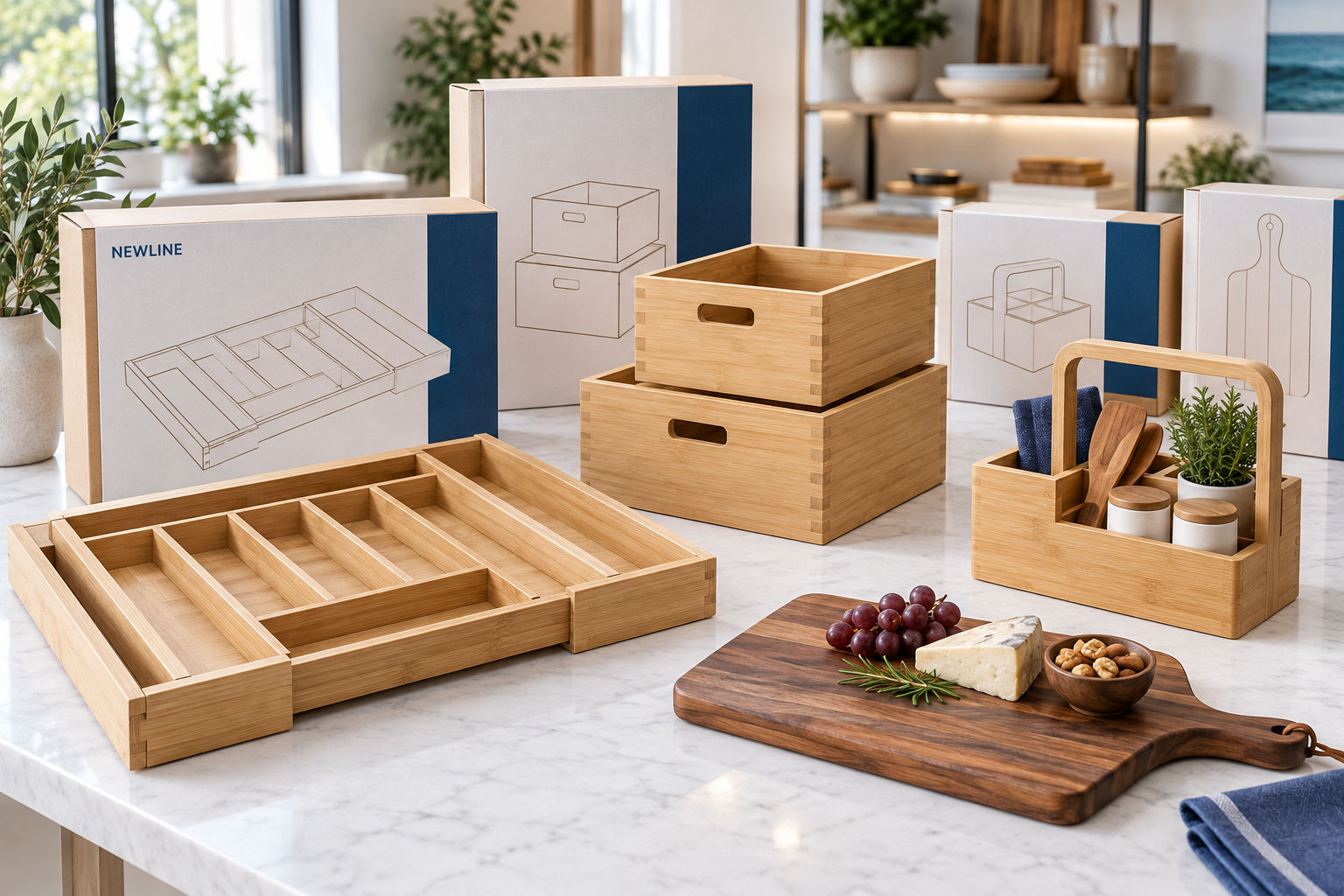
Planning a drawer organizer or coordinated storage range?
Share the channel, target retail ladder, candidate SKUs, expected volumes and packaging constraints. We can help separate common platforms from product-specific risks before the assortment becomes expensive.
17. Break lead time into events the team can manage
A single “45-day lead time” hides the work before and after production. Build a schedule with separate events: commercial brief, drawing, prototype, sample revisions, finish approval, packaging structure, artwork, testing, purchase order, material preparation, production, final inspection, booking and shipment. State which approval releases each stage. The clock should not begin while critical inputs remain open.
Mark every item that follows a different clock from the bamboo parts. Printed boxes, custom pads, hardware, laboratory slots and peak-season vessel space can all sit on the critical path. Ask for the last safe release date and the cost of changing the item afterward. Leave room for a buyer to review a proof or sample. A schedule with no decision time is already late; it simply has not shown the delay yet.
Chinese public holidays, destination retail windows, port conditions and seasonal humidity can affect planning. Use dated milestones and a latest acceptable decision date. If the launch window cannot move, rank which parts of the program can remain standard for the pilot. Airfreighting a bulky organizer to recover a late artwork decision can erase the margin the product was designed to earn.
Capacity claims should be translated into order-specific commitments. Ask which line or process is expected to handle the order, what other work shares the period, how materials will be secured and when the supplier will signal a risk. A production update should report completed quantity, quality status, open problems and next milestone. Photographs are helpful when tied to dates and batches.
Reorder lead time is not automatically the same as the first order. Tooling and files may be ready, but material, packaging inventory, seasonal demand and capacity can change. Agree how forecasts are shared, how long prices remain valid, whether printed materials are held, and which approvals can be reused. Build the replenishment calendar backward from the stock-cover threshold, not from the day inventory is already low.
18. Use a 90-day launch plan with measurable gates
Use the opening month to check the launch, not to celebrate it. Pull a few sellable units and compare them with the reference product and pack. Confirm that the live listing uses the approved measurements, that inventory can be traced, and that service agents know how to record a fit problem. Replace prototype photography wherever the production item changed. Early corrections to copy and setup are cheap; letting the same confusion run for a season is not.
Days 31 to 60 should focus on comprehension and defects. Review search terms, pre-purchase questions, return reasons, photographs and reviews. Separate “does not fit my drawer” into its causes: shopper did not measure, listing was unclear, stated product size was wrong, working range was misleading, or production dimensions were out of control. The corrective action differs for each cause.
Days 61 to 90 should support the reorder decision. Compare actual selling price, promotion depth, fulfillment cost, damage, returns and service cost with the original model. Review size and configuration performance. Decide whether to reorder unchanged, revise content, revise packaging, correct product, add a size, reduce assortment or stop. Do not allow enthusiasm about gross sales to hide a weak contribution margin.
Set scale gates before launch. Example gates might include confirmed fit communication, no unresolved safety issue, acceptable pack condition, stable dimensional inspection, complete traceability and a reorder margin above the buyer's threshold. The exact metrics belong to the retailer. The discipline matters: scaling follows evidence rather than a calendar date alone.
Share useful field information with the manufacturer. Photographs of failures, drawer dimensions, lot codes and packaging condition are far more actionable than a generic complaint. The supplier should respond with containment, analysis and proposed correction. Keep the improvement record with the next purchase order so learning becomes part of the product rather than a forgotten email thread.
19. Read returns and reviews as a product-development dataset
Return codes are often too broad. Create categories that connect to action: too wide at compact size, too narrow at maximum working range, too deep, too tall when loaded, wing slips, wing binds, divider missing, surface rough, color expectation, odor, transit damage, wrong item, instruction confusion and no-fault change of mind. Customer-service notes should capture measurements or photographs where appropriate and permitted.
Review language contains context that inspection cannot simulate. A shopper may say the organizer fits but wastes space, holds forks poorly, traps crumbs, marks a drawer or looks different from the listing. Count recurring themes, but read representative examples. A low-frequency issue can still be serious if it relates to safety or compliance; a high-frequency preference may support a future variant rather than a defect claim.
Connect field data to lot and revision. If a problem appears only after a packaging supplier change, holiday production period or revised coating, the batch history helps isolate it. If the same issue appears across all lots, the design or message may be wrong. Without traceability, every complaint becomes an argument about averages.
Use a closed-loop review with commercial, quality and supplier teams. Decide whether the action belongs in product geometry, process control, packaging, content, instruction or channel targeting. Assign an owner and verify effectiveness after the change. Updating a listing can immediately reduce measurement errors; changing a rail should follow sample and production approval.
20. Protect reorders with revision and reference control
A reorder should reference the approved drawing, bill of materials, finish standard, product sample, packaging structure, artwork, tests and inspection checklist. Use revision identifiers in the purchase order. The supplier should disclose any proposed material, process, component, site or packaging change before production. “Same as last time” is not a specification.
Review aged or stored components. Printed boxes may have changed color, absorbed moisture or become obsolete after a barcode or address update. Pads and adhesives can have shelf-life considerations. Retained product samples may no longer represent the current limit if they were exposed to light or humidity. Confirm which references remain valid and replace them under control.
Use first-article checks on every batch for the critical fit and expansion characteristics, even when the design is unchanged. Natural-material input, operators, tooling condition and climate vary. The scope can be efficient, but the early gate should prevent a full run of binding wings or wrong dimensions. Reorder confidence comes from repeatable controls, not familiarity.
When a commercial change is intentional, model its full effect. A new box size may change cube and transport validation. A darker finish may change coating setup and appearance limits. A new divider may change fit, count and instructions. A new marketplace label can cover a required panel. One small request can touch product, cost, compliance, timing and inventory.
21. Ten high-intent buyer FAQs
| No. | Buyer question | Practical answer | What to include in the RFQ or approval |
|---|---|---|---|
| 1 | What determines the wholesale price of an expandable bamboo drawer organizer? | Finished dimensions, material construction, machining, expansion design, wall and panel thickness, finish, dividers, pads, logo, quality controls, packaging, order quantity and trade term all affect price. Compare suppliers against one controlled revision and one Incoterm. | Dimensioned drawing, material and finish brief, pack format, quantity tiers, destination and list of included tests and services. |
| 2 | What MOQ should a retailer expect? | There is no universal MOQ. Product setup, coating batch, packaging print and scheduling may each create a different minimum. Ask which constraint applies per model, finish, artwork and shipment, then cost a pilot and realistic reorder separately. | SKU matrix, pilot volume, annual scenario, mixed-SKU request, packaging option and launch calendar. |
| 3 | How can buyers confirm that the organizer fits common drawers? | Use measured internal drawer width, depth and clear-height data from the target market. Test compact, middle and maximum working widths in real drawers. Communicate product and required drawer dimensions separately; avoid an unqualified universal-fit claim. | Measurement dataset, coverage target, working-range drawing, real-drawer test record and customer measurement graphic. |
| 4 | Which packaging works for retail and e-commerce? | Retail packaging prioritizes shelf communication, presentation and case handling; e-commerce packaging must also manage single-parcel impacts and movement. One design may serve both only after the actual route is validated with the production-intent product. | Channel map, unit pack, case pack, carton data, artwork, restraint method, route-specific test protocol and pass criteria. |
| 5 | How should landed cost be compared? | Add product, pack, one-time cost allocation, testing, inspection, origin charges, freight, insurance, duty, clearance, destination handling, receiving, fulfillment and a justified allowance for damage or returns. Date every external assumption. | Normalized quote, packed dimensions and weight, tariff review, logistics scenario, payment terms and expected/downside/scale margin model. |
| 6 | Can size, compartments, logo and packaging be customized? | They can be evaluated for customization, but every change may affect tooling, testing, MOQ, cost and timing. Low-risk branding changes should be separated from structural changes. Approve revisions through drawings, samples and artwork files. | Ranked requirements, open decisions, artwork files, target range, brand rules and change-control owner. |
| 7 | How is natural bamboo variation controlled? | Approve representative high and low appearance limits, define visible zones and inspect under agreed lighting. Natural variation should be expected, while rough touch points, severe mismatch, uncontrolled repairs or finish defects require defined limits. | Physical range board, surface-zone map, finish reference, cosmetic defect list and inspection method. |
| 8 | What quality checks matter before shipment? | Verify identity, quantity, compact and expanded dimensions, safe overlap, movement, squareness, rocking, divider fit, touch points, finish, odor, pads, accessories, artwork, barcode, pack-out, carton data and route-relevant packaging performance. | Lot definition, sample plan, defect classes, measurement points, function methods, report format and disposition authority. |
| 9 | How should FSC or sustainability claims be verified? | Confirm the certified organization's scope, product eligibility, transaction claim and trademark approval for the exact order. Broader environmental claims need their own boundaries and evidence; bamboo appearance alone does not validate them. | Exact claim text, certificate and scope check, invoice flow, artwork approval, responsible owner and validity dates. |
| 10 | What information produces the fastest useful quotation? | A useful brief states intended use, target shopper and channel, internal drawer range, product dimensions, layout, material, finish, branding, pack, destination, quantity tiers, target launch, test requirements and open decisions. A reference photo without measurements is not enough. | One-page commercial brief, controlled drawing or measurement sketch, target cost logic, forecast, destination and decision schedule. |
22. Send an RFQ that a supplier can answer without guessing
- State the consumer job, target shopper, sales channel and destination market.
- Provide measured internal drawer width, depth and clear-height data or identify the assumptions.
- Mark compact size, maximum working size, compartment layout and included dividers.
- Describe material construction, visible zones, finish, touch-point expectations and care direction.
- Identify logo method, barcode owner, required languages, claims and retailer labeling rules.
- Specify unit pack, master-carton objective, case pack, pallet or floor-load constraints and e-commerce route.
- Request pilot, reorder and scale quantity tiers, stating whether minimums are per SKU, finish and artwork.
- Name the Incoterm and location, currency, payment assumptions, quotation validity and launch window.
- List tests, inspection expectations, defect priorities, approval samples and required reports.
- Separate fixed requirements, preferred features and open design decisions.
- Ask for one-time costs, excluded costs, packed dimensions, gross weight and estimated loading data.
- Require disclosure of manufacturing sites, subcontracted processes and proposed post-approval changes.
A complete RFQ does not prevent supplier questions. It makes those questions useful. The goal is to expose decisions that influence fit, cost, pack, margin and schedule while they are still cheap to change. Invite suppliers to identify contradictions and propose costed alternatives. Record the accepted answer in the next revision rather than leaving it in a chat thread.
23. How Newline supports a wholesale organizer program
Ningbo Newline develops and coordinates bamboo and wood household products across home storage, kitchen, bathroom and office organization. Buyers comparing expandable bamboo drawer organizers wholesale can begin with a defined concept, a current sample that needs improvement, or a market and cost brief. The work then moves through product definition, construction review, sample approval, branding, packaging, quality planning and export execution.
Our role is to make the commercial assumptions visible. Fit range, feature hierarchy, quantity tiers, packaging route, claims and inspection cannot remain separate conversations. When those decisions are connected, a buyer receives a quotation that is easier to compare and a sample that is more likely to represent the sellable program.
For an initial review, send the target drawer measurements, preferred layout, reference images, destination, channel, volume tiers, target retail position and launch timing. If the design is still open, explain the problem and budget boundary instead of inventing details. We can return the questions and options that most affect feasibility, MOQ, packed cube, cost and validation.
Ready to cost a retail-ready organizer?
Send your drawer range, target quantity, destination and packaging channel. Include a drawing or reference photo if available. Newline will help turn the request into a comparable OEM brief rather than a generic catalog price.
Authoritative references used for this guide
- European Union, Regulation (EU) 2023/988 on general product safety.
- European Union, Regulation (EC) No 1935/2004 on materials and articles intended to come into contact with food.
- Forest Stewardship Council, Chain of Custody Certification.
- International Safe Transit Association, packaged-product test procedures.
- GS1, barcode standards and identification overview.
This guide is for commercial sourcing and product-development planning. It is not legal advice, a laboratory report or a substitute for product-specific market review. Confirm current obligations and test scope with qualified specialists for the finished product and destination.