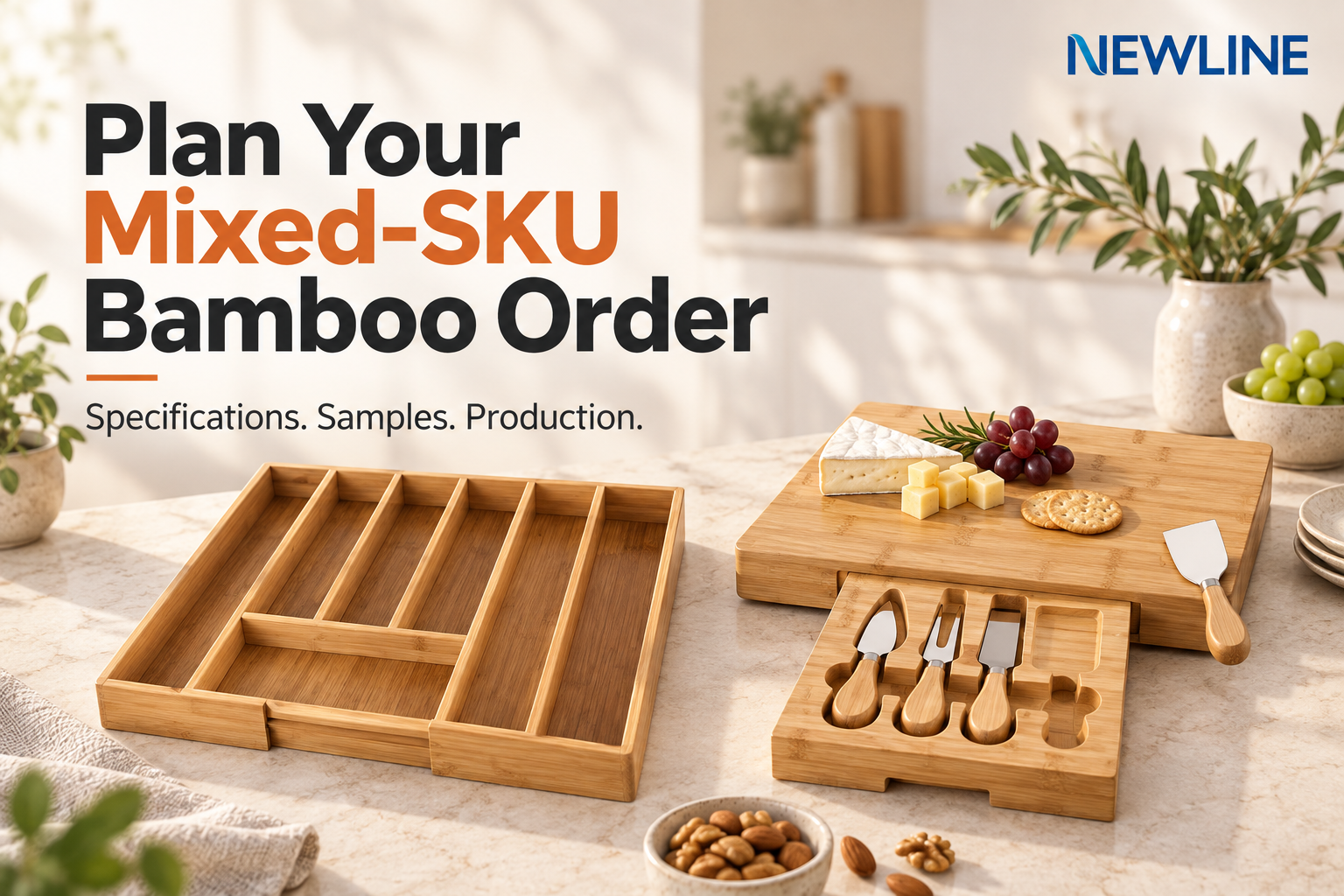
 A drawer organizer is approved. The cheese-board sleeve is still with the designer. The laundry basket needs a decision on the inner bag. All three appear on the same purchase order, but only one is ready to move forward. This is the practical problem behind many mixed-SKU buying discussions: a collection has one launch date and several separate approval paths.
For a mixed-SKU bamboo products order, agree the assortment, specification version, quantity per item, packaging and approval status before treating a combined quotation as a production plan. Ten stock keeping units (SKUs) on one purchase order still represent ten sets of product decisions. Shared branding does not make their dimensions, components or inspection requirements interchangeable.
This guide helps importers, distributors and private-label brands prepare that order for searching the responsible bamboo products OEM manufacturer. It includes a reusable assortment matrix, a worked carton-volume example, a sample-release checklist and a practical request for quotation. Newline catalogue references illustrate the questions to ask. They are starting points for discussion, not promises of stock availability, order minimums or lead times.
1. Decide what the collection must do before choosing its size
Start with the buyer's commercial brief: who will purchase the range, where it will be sold and which everyday problem each item solves. A kitchen organization collection can be coherent even when the products have different shapes. The connection might be tidy preparation spaces, a consistent natural appearance and packaging that works together on a shelf.
Give each proposed item a role. An anchor product carries the main launch story. A companion product supports that story and makes the selection more useful. A trial product tests a new category with a deliberately limited commitment. These roles help a buyer decide what must ship together and what can wait if an approval issue develops.
Do not use the first order to test every possible variation. Every additional size, finish, logo position and pack configuration introduces another choice to confirm. Ask whether the variation answers a real channel requirement. If two options solve the same problem for the same customer, selecting one for the launch may make sample review and replenishment easier.
A three-product launch: make the dependency visible
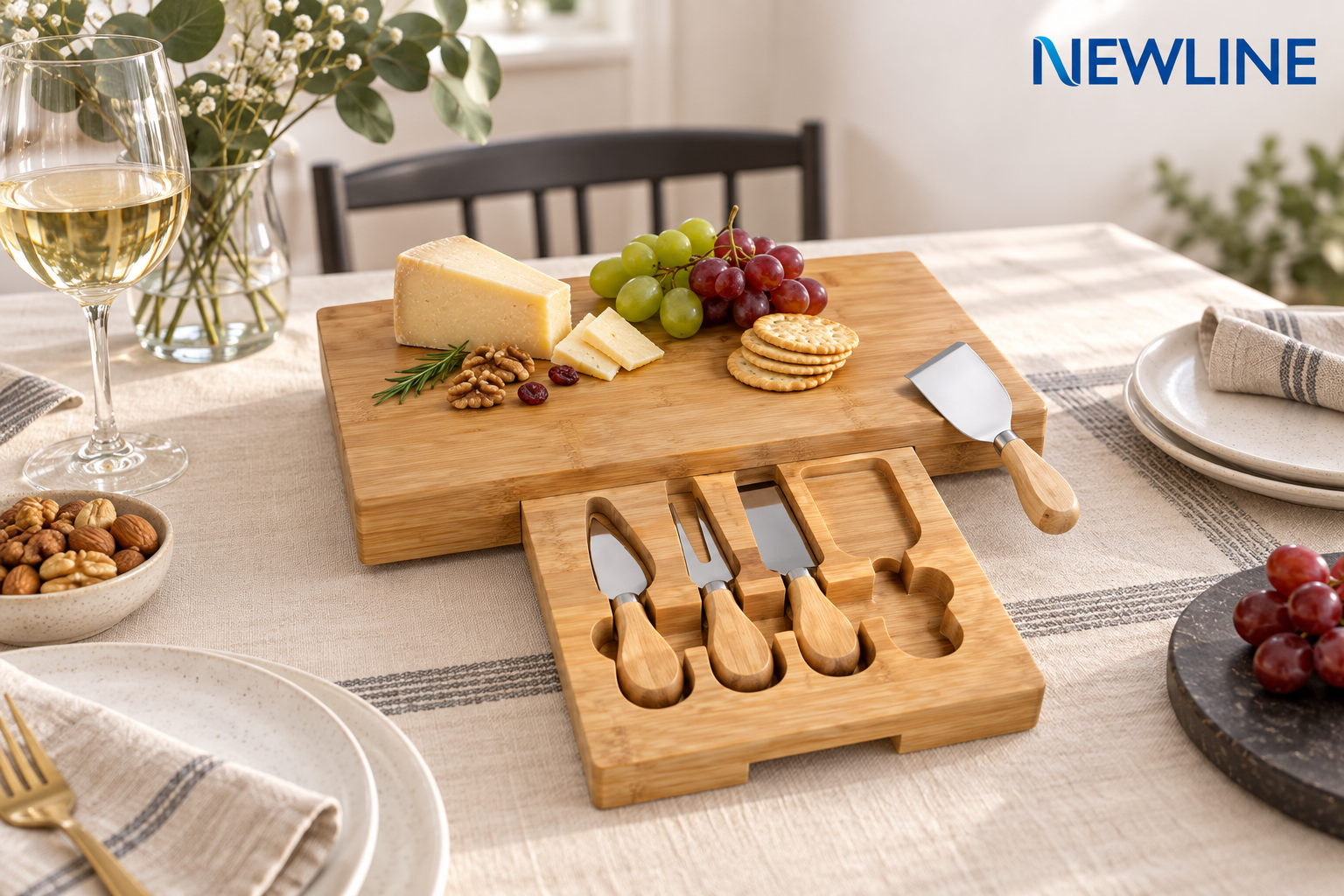
For example consider a planning using BW0207, BW0318 and BW0495. This is an illustrative buying exercise, not a report of a completed Newline customer order. The organizer is intended for an ongoing kitchen range, the cheese board for gifting, and the basket for a small bathroom-storage trial u could all follow from this bamboo products OEM manufacturer.
| Proposed line | Launch role | Decision still needed | Effect on the buying plan |
|---|---|---|---|
| BW0207 organizer | Core kitchen item | Confirm fit against the buyer's target drawer | Release only after the fit check is recorded |
| BW0318 cheese board | Gift item | Approve tools, insert and printed sleeve together | Keep packaging approval separate from board approval |
| BW0495 laundry basket | Trial item | Confirm liner and shipped configuration | Decide whether the trial may travel separately |
 2. Build one assortment matrix with a separate row for every SKU
An assortment matrix connects commercial choices with production information. Keep it short enough to use in a meeting, but specific enough that a supplier can identify what still needs an answer. A row should refer to one product and one sellable configuration. If a product is offered with two different accessory sets, record them separately.
| Field | What the buyer supplies | What needs confirmation |
|---|---|---|
| Item identity | Buyer SKU, Newline reference and image | Same product and current revision |
| Channel and market | Country, retail, distribution or online channel | Applicable product and packaging requirements |
| Function | Intended use and essential features | Feasible construction and use boundaries |
| Dimensions | Required usable space and overall envelope | Drawing, measurement points and tolerances |
| Quantity | Initial quantity for each configuration | MOQ, quantity breaks and order conditions |
| Branding | Artwork, position and target appearance | Method, sample and approval version |
| Packaging | Unit pack, case pack and distribution route | Packed sample, dimensions and gross weight |
| Timing | Required warehouse date and priorities | Approval, production and dispatch milestones |
| Release status | Owner and outstanding decisions | Written approval before production release |
Use a document revision and a date in the filename. Keep a brief change log within the document itself. An email saying “please use the updated box” does not reliably identify whether the update concerns the artwork, construction, barcode or quantity per carton. Those changes can affect different people and different materials.
Record unanswered fields as open questions. Avoid completing them with a number copied from a similar product. A different panel thickness, drawer mechanism or packaging insert can change the quotation and the packed size. Keeping the gap visible is more useful than making the spreadsheet appear complete.
3. Use catalogue dimensions correctly when defining the order
Catalogue measurements are useful for shortlisting. They do not describe every dimension that matters in use. A drawer organizer has external dimensions, an adjustment range, individual compartment sizes and clearance requirements. A laundry basket has an outer envelope and a usable interior. A puzzle surface has overall dimensions and a working area that may be smaller.
The following examples come from Newline's 2026 catalogue. Dimensions reproduce the catalogue notation in centimetres. Confirm measurement orientation, current construction and the approved drawing before ordering. The examples demonstrate how to prepare questions; they are not substitutes for a signed specification.
| Catalogue reference | Listed format | Catalogue dimensions | Next question for the order |
|---|---|---|---|
| BW0207, page 16 | Retractable storage box | (33–49) × 42 × 6 cm | Which dimension adjusts, and what clearances are required inside the drawer? |
| BW0318, page 9 | Cheese board with tools | 40 × 20 × 2.5 cm | What components and tools are included in the offered configuration? |
| BW0508, page 26 | Stretchable bathtub tray | 75–107.5 × 22.8 × 3.0 cm; folded 37.5 × 22.8 × 5.8 cm | How do the supports engage the intended bathtub edges? |
| BW0495, page 30 | Laundry basket with inner bag | 42 × 34 × 71 cm | What is the usable internal space and the supplied liner specification? |
| BW0163, page 47 | Puzzle table with six drawers | 78 × 78 × 4.5 cm | What is the usable puzzle area, and how are drawers secured in transit? |
For BW0207, ask for a drawing showing the product in its closed and extended positions. Measure the target drawer at the narrowest usable points, including any hardware intrusion. An organizer that fits the nominal cabinet width may still interfere with a curved drawer wall, a handle fixing or a drawer that does not open fully.
For BW0318, define the tool assortment as a bill of materials rather than relying on the photograph alone. A bill of materials lists the parts that make up the finished item. It should distinguish the board, tool drawer, each utensil, any protective insert and the packaging. Check the current sample against that list before approving images for the retail box.
For BW0495, resist converting the outer dimensions directly into an advertised capacity. The frame, liner attachment and shape of the interior reduce usable space. A capacity claim needs its own defined measurement. The same principle applies to puzzle boards: the number of puzzle pieces is not a universal size specification because finished puzzle dimensions differ.
4. Connect each product family to the right manufacturing discussion
The ten manufacturer topics below are entry points into a collection, not ten phrases to repeat throughout a purchase order. Use the relevant link to explore the current range, then attach the actual product reference to your inquiry. Several categories can share a commercial program while retaining their own specifications and acceptance criteria.
| Manufacturing discussion | Current Newline range or capability | Information to include in the inquiry |
|---|---|---|
| bamboo drawer organizer manufacturer | Drawer organizer product | Drawer interior, adjustment range, compartment layout and quantity |
| bamboo cutting board manufacturer | Cutting board product | Intended use, dimensions, thickness, finish and pack format |
| bamboo charcuterie board manufacturer | Cheese boards and related kitchen products | Tool list, drawer design, gift packaging and branding |
| bamboo spice rack manufacturer | Kitchen storage | Bottle envelope, shelf arrangement, assembly and display needs |
| bamboo bathtub caddy manufacturer | Bathtub tray product | Tub geometry, support arrangement, storage and care expectations |
| bamboo bathroom shelf manufacturer | BW1269 corner shelf with metal frame | Component materials, usable shelf space and installation context |
| bamboo laundry basket manufacturer | Bathroom storage and catalogue laundry options | Liner, internal space, assembly and case-packing requirements |
| bamboo desk organizer manufacturer | Office and desktop organization | Items stored, document sizes, usable dimensions and branding |
| puzzle board with drawers manufacturer | Product catalogue; request BW0163 details | Working surface, drawer arrangement, packing and target puzzle sizes |
| bamboo products OEM manufacturer | OEM and ODM project discussion | Product brief, drawings, assortment matrix and launch priorities |
Some catalogue items may require a direct specification request rather than having a dedicated online product page. Include the reference number and the catalogue image so the team can confirm the model. A broad category page shows the range context; it does not establish that every configuration is immediately available.
5. Separate product MOQ from the size of the combined order
A mixed order does not automatically create a shared minimum order quantity. One item may use an existing construction while another needs a dedicated component or printed insert. The relevant minimum may depend on the product, finish, accessory, decoration method or packaging specification. Ask which condition creates each minimum before changing the assortment.
Separate product quantity from packaging quantity. A printer's production run may exceed the number of finished goods in the first order. If unused packaging is retained for a later run, agree who owns it, how it is identified, where it is stored and what happens if artwork changes. Do not assume that leftover packaging is free or suitable indefinitely.
Evaluate alternatives in a controlled way. Ask for the requested configuration first, then one clearly identified alternative if it solves a constraint. For example, compare a custom printed box with an agreed standard box and label. Keep both quotations tied to their specifications so a lower number is not mistaken for the same offer.
Newline's order quantities, prices and schedules should be confirmed against the selected models and current project scope. This guide intentionally supplies no universal MOQ or delivery promise. A useful inquiry gives the team enough detail to quote the actual work.
6. Approve samples by decision, not by appearance alone
A sample review should answer a defined set of questions. The product may look suitable while the final packaging, accessories or care information remain unresolved. Record which elements are approved and which are still provisional. “Sample approved” is too broad if different people understand it differently.
Next, review the intended use. Put actual cutlery into a drawer organizer. Place the intended bottles on the spice rack. Check a desk organizer with the document formats the retailer will advertise. A simple practical check can reveal an awkward compartment or an inaccessible feature before it becomes a repeated customer complaint.
Record measurable criteria for the features that matter. Identify where dimensions are measured, how movement is checked and what constitutes an unacceptable finish defect. Avoid copying a tolerance from another product without considering the construction. The proposed limit needs to be both useful to the buyer and feasible for the agreed manufacturing process.
Then review the packed sample as a finished sellable item. Confirm that accessories remain in place, the presentation is understandable and the box identifies the correct product. For a product with a drawer, check how movement is restrained during packing. For an assembled basket or shelf, verify that the chosen packaging matches the actual shipped configuration.
| Approval gate | Evidence to retain | Release question |
|---|---|---|
| Product configuration | Drawing, sample ID and component list | Is this the exact configuration being ordered? |
| Function and fit | Measurements, observations and agreed criteria | Does the sample meet the intended use requirements? |
| Appearance and branding | Approved physical reference and artwork revision | Can production compare against an identifiable standard? |
| Unit packaging | Packed sample, copy and barcode proof | Is the sellable item complete and correctly identified? |
| Export carton | Case count, label and packing specification | Can the warehouse receive and handle it as intended? |
| Production release | Written decision with outstanding issues resolved | Has the authorized buyer approved the defined scope? |
7. Plan carton volume before changing the product mix
Carton volume turns an assortment discussion into a logistics discussion. A product with a modest unit price can still occupy substantial shipping space. Compare packed dimensions and units per carton, then consider how the cartons will actually be consolidated. Overall product dimensions are not a reliable substitute for export-carton measurements.
The calculation is straightforward: carton length multiplied by width multiplied by height, all in metres, gives cubic metres per carton. Multiply that figure by the carton count for the line total. Keep the original measurements beside the calculation so another person can check the units.
Here is an illustrative calculation, not a Newline packing specification or freight quotation. Suppose a packed carton measures 0.50 × 0.40 × 0.30 metres and contains eight units. For this example, enter 0.06 m³ in the carton-volume field. The purchasing sheet would show 160 finished units spread across twenty cartons, with 1.20 m³ as the sum of their external volumes. Keep that figure separate from any booked freight space.
| Illustrative input | Calculation | Result |
|---|---|---|
| One carton | 0.50 × 0.40 × 0.30 m | 0.06 m³ |
| Twenty cartons | 20 × 0.06 m³ | 1.20 m³ |
| Product units | 20 cartons × 8 units | 160 units |
| Packed volume per unit | 0.06 m³ ÷ 8 units | 0.0075 m³ |
There is still no container-loading answer in this worksheet. Actual loading also depends on carton shapes, stacking limits, weight, handling arrangements and unused spaces. A loading plan needs the full collection of carton sizes and the freight provider's confirmation. Dividing a nominal container volume by one carton volume is only an early approximation.
Compare alternatives on the same basis. An assembled shelf and a flat-packed shelf may have different packing volumes, but the latter also introduces assembly instructions, hardware control and a different receiving experience. The useful comparison includes all those consequences rather than treating space reduction as the only objective.

Ask for packing options you can actually compare
For an expandable organizer, request packed measurements in the agreed shipping position. Do not price freight using the maximum extended product size unless that is how it will be packed. For a tool-drawer board, ask how the drawer and loose parts are held in place. For a laundry basket, specify whether the shipment contains assembled units or components for assembly. These three questions concern different packing problems even when the products share the same brand artwork.
If you request a more compact packing proposal, ask the supplier to show what changed: carton dimensions, units per carton, protection or product configuration. Then review the packed sample. A spreadsheet with a smaller cubic-metre total cannot show whether a buyer will find loose tools, rubbing surfaces or confusing components when opening the unit.
8. Give every sellable unit and carton a reliable identity
Mixed-SKU orders need clear product identification because similar-looking goods can be easy to confuse. A buyer SKU, a manufacturer's reference and a retail barcode serve different purposes. Keep the relationships in the assortment matrix instead of expecting the warehouse to infer them from a product name.
The GS1 GTIN Management Standard, Release 1.1, September 2023, explains how trade items are uniquely identified and sets out rules for changes to products and assortments. Use the official GS1 standard when deciding whether a changed item or predefined assortment requires a different GTIN. A barcode should be part of controlled product data, not a graphic copied from a previous box.
Agree what appears on export cartons: purchase-order reference, product identifier, quantity, carton number and any required handling information. Align the fields with the receiving warehouse's process. A distribution centre may need data in a particular order, while a smaller importer may use a simpler receiving sheet.
If different SKUs share a carton, treat that as a deliberate packing configuration. Provide a contents list and agree how shortages will be recorded. Single-SKU cartons can simplify counting, but the right choice depends on the channel and shipment. The decision should be made before goods reach the packing station.
9. Make the shipment schedule depend on real approvals
A desired warehouse date is a commercial objective. It is not the same as a production start date, a ready-to-ship date or a vessel arrival date. Put those milestones on separate lines and identify the assumptions behind them. Otherwise, two people may agree on “delivery” while referring to different events.
Track each SKU separately until its release conditions are satisfied. A straightforward organizer may be ready while a gift set still needs packaging approval. Decide whether the collection must ship together or whether the business can accept a partial shipment. Make that decision using the launch roles established at the start.
A useful status report names the next decision rather than offering only a percentage complete. “Artwork approval required for the cheese-board sleeve” tells the buyer what action is needed. “Order is nearly ready” does not identify the remaining risk or the person who can resolve it.
10. Compare the complete commercial scope of quotations
When comparing manufacturing proposals, first check whether they describe the same product. A lower price may exclude tools, decoration, a retail box or a particular inspection step. Create a comparison column for each meaningful inclusion. Ask for clarification before treating a difference as a saving.
Shipping responsibilities also need a clear basis. The International Chamber of Commerce's Incoterms® 2020 guidance explains that the rules allocate buyer and seller obligations, costs and risks. Identify the agreed rule and named place in the quotation discussion, and confirm the actual transport arrangement with the parties handling it.
For the buying worksheet, keep product cost, packaging, agreed services and estimated logistics in separate fields. That allows the team to revise an estimate without accidentally changing the manufacturer quotation. Currency and quotation validity should also be visible. An old offer is not automatically the current price.
Before placing the order, reconcile the selected offer with the approved assortment matrix. The same quantity, revision, accessories and packaging should appear in both. Resolve differences in writing. This last comparison is a practical way to catch a mismatch between the version that was sampled and the version that was priced.
11. Prepare an inquiry that can receive a useful answer
Start the request for quotation with the buying decision that is due next. Perhaps the team needs to choose between a stock board and a revised tool layout. Perhaps it needs packed dimensions before approving a basket trial. Name the decision, list the shortlisted references and state which quantities are estimates. A supplier can then answer the open question without treating provisional information as a production instruction.
Specify the customization level. Existing product with a logo, revised dimensions and a fully new design are different starting points. Include available drawings and artwork, identify what you own or are authorized to use, and describe any features that must remain unchanged. If a file is not ready, name the decision still being worked on.
The inquiry below is a fill-in worksheet. Remove any request that does not apply, and replace every bracketed field before sending it:
Company and destination market: [company; market; sales channel]. We are evaluating a coordinated bamboo and wood housewares order for [launch objective]. Our initial shortlist is [references], with [quantity] per configuration. Please confirm the offered construction, component list, MOQ and sample process. We need [branding] and [unit packaging]. Please quote case count, carton dimensions and gross weight separately. Our required warehouse timing is [date or window]. Please identify the approvals needed before a production schedule can be confirmed, and flag any specification gaps in the attached assortment matrix.
Add one clear request for the next step: a specification review, a sample proposal or a comparable quotation. Asking for everything without priorities can slow the useful answer. For a shortlisted board, that next step might simply be confirmation of the tool list and a photograph of the offered packed set.
Check the quotation against the receiving desk
Give the draft packing summary to the receiving team before the quotation request goes out. Procurement may recognize a catalogue reference immediately; a receiving operator may only see an outer carton and a delivery note. The documents need to connect those two views. Have that team describe how it would count the delivery from the proposed labels. If the answer requires opening each box, revise the label brief before asking the supplier to print it.
In the example used here, BW0207, BW0318 and BW0495 belong on three separate receiving lines. Record the buyer SKU beside the catalogue reference. Keep the unit count separate from the carton count. If a gift board contains several tools, describe those as components of one sellable set instead of allowing the tools to inflate the finished-unit total.
One useful final question is: “What will our receiving team do if a carton contains the wrong configuration?” Agree what evidence to capture, who reviews it and how the affected units will be identified while the issue is investigated. This is a proposed workflow for the buyer and supplier to discuss, not a statement of Newline's standard claims procedure. Put the agreed process alongside the order documents so the receiving team can use it when needed.
12. Plan the reorder before the first cartons leave
A first order creates a set of decisions that should be reusable. Retain the approved drawings, component list, artwork, packing configuration and acceptance criteria together. Give the collection a stable reference so the next buyer or account contact does not have to reconstruct it from separate email threads.
Treat a reorder change as a controlled revision. A new box design, a different tool or a revised dimension can affect more than the appearance. Check the sample requirements, product identification and packing data again. A short revision review is easier to manage than discovering two different configurations under one item description.
Frequently asked questions about mixed-SKU bamboo orders
Can different bamboo products be placed in one OEM order?
Send the shortlist as separate order lines and ask Newline to review the proposed combination. For BW0318, the outstanding question might concern its tool set; for BW0495, it might be the liner and assembly format. Those questions need their own answers even when both products sit on the same purchase order. Request confirmation of the quantity, customization and packing scope for each line before agreeing a shared schedule.
Does combining products reduce the MOQ for every item?
Not necessarily. A minimum can arise from a product construction, accessory, decoration or packaging run. Ask for the reason behind each minimum and for one practical alternative where needed. A mixed shipment may help organize purchasing, but it should not be presented as proof that every SKU has the same order conditions.
Should we start with custom dimensions or an existing model?
Begin with the actual use requirement. If an existing model fits that requirement, reviewing its current specification may be an efficient first step. If it does not, provide the required dimensions and explain why they matter. Ask how a change affects sampling, tooling, packaging and order conditions before selecting the development route.
How do we avoid approving a beautiful but impractical sample?
Test the sample against the intended use and the written specification. Use the actual drawer, utensils, bottles or document formats where practical. Check the packed configuration as well as the product. Record which features pass, which need revision and who has authority to release the final version. Appearance is one part of approval, not the whole decision.
Can the manufacturer use one packaging design for the entire range?
The collection can share a visual style, but each item still needs accurate dimensions, contents, identification and care information. Confirm whether the box construction suits that particular product. A common design system can simplify the range while separate artwork versions preserve the details needed for each sellable item.
What should we do if one item delays a combined shipment?
Return to the launch-role column in the assortment matrix. If the delayed item is the main advertised product, shipping its companions alone may not help the buyer. If it is a trial item, a separate shipment may deserve a cost comparison. Ask for both the revised timing and the additional packing or transport arrangements before choosing. Record who accepted the change and which order lines it covers.
Do catalogue photographs prove the exact contents of a retail set?
No. Use a confirmed component list and an approved sample to establish the order contents. Food, household objects and decorative props in lifestyle images illustrate use. They are not automatically included. For gift sets, identify every supplied tool and insert explicitly so the retail description matches the finished product.
What information should we send Newline first?
Send your company name, business email, target market, product references and estimated quantity per item. Add the customization level, packaging needs and target timing. If you have not completed the assortment, send the current shortlist and the decisions you need help resolving. That is enough to start a focused specification discussion without inventing missing details.
Turn your shortlist into an actionable manufacturing brief
Newline's catalogue spans kitchen, bathroom, office and other household formats. Use the references in this guide to start the conversation, then request the current specifications and project-specific commercial conditions. For a mixed-SKU program, include your company, target market, quantities, branding and packing priorities in the contact message.
Ready to review your range? Send Newline your shortlist and request a mixed-SKU OEM quotation with the specification questions, sample steps and packing details clearly separated.
In the contact form, begin your message with “Mixed-SKU OEM quotation” and include these five details in your message: product references, quantity per reference, destination market, logo or packaging changes, and required timing. If your shortlist is still provisional, say which decision you need to resolve first. You can request a specification review before committing to a final assortment.